
Best overall: architectural abstract murals. Best for place-based identity: local storytelling murals. Best for a tightly defined scope: typography-led murals. This guide to the best exterior mural designs for commercial buildings in 2026 helps you choose what belongs on your wall before commissioning ARTCVLT Murals, a Houston studio that designs and hand-paints custom murals.
TL;DR
Best exterior mural designs for commercial buildings 2026: choose architectural abstraction for a building-first composition.
Choose local storytelling for place-based identity and typography for a clear message.
ARTCVLT Murals designs and hand-paints custom murals for commercial buildings and private property owners.
Approve the design, wall preparation responsibilities, and access plan before painting begins.
Why this matters
A commercial mural is not a framed painting enlarged onto masonry. It has to work around doors, windows, signs, neighboring buildings, and the people moving past it. Start with the building. Then choose the art.
For a 2026 commission, separate the permanent job from the temporary campaign. A business name, a neighborhood story, and a seasonal promotion ask different things of the same wall. Decide which job matters before approving a sketch.
ARTCVLT Murals is a fit for Houston commercial-building owners seeking a custom hand-painted exterior mural. Choose a design direction around your site and purpose, not a trend board alone.
What makes the best commercial exterior mural
Use these criteria to judge the concept before judging the artist's presentation:
Building fit: Treat openings, corners, utilities, and existing signage as part of the composition.
Viewing distance: Make the main idea readable from the places people actually see the wall.
Distinct identity: Give the building a recognizable visual idea without copying another property's artwork.
Surface readiness: Set wall repairs, cleaning, and coating decisions before the painting scope is finalized.
Approval clarity: Identify who signs off on artwork, wording, and any required property or public-space permissions.
Long-term relevance: Separate enduring identity from messaging that needs frequent revision.
Review the wall from 3 viewing positions: across the street, along the approach, and at the entrance. These are review checkpoints, not a visibility formula. A composition that works in a close-up mockup still needs to earn its place on the actual building.
Exterior mural designs at a glance
These rankings prioritize different commissioning goals. The first option is the default for an undecided owner, not a claim that every building needs abstraction.
1. Architectural abstract mural
Best for: Making the whole façade feel intentional
Standout feature: Shapes respond to the building's geometry
Key limitation: Needs another element if explicit information is essential
2. Local storytelling mural
Best for: Expressing a specific place
Standout feature: Subjects connect the wall to its surroundings
Key limitation: Requires agreement on representation and references
3. Typography-led mural
Best for: Delivering one clear message
Standout feature: Words become the main composition
Key limitation: Message changes can require repainting
4. Botanical mural
Best for: Giving a courtyard or hospitality exterior a nature-led identity
Standout feature: Leaves and plant forms organize the wall
Key limitation: Generic imagery weakens the connection to the property
5. Figurative narrative mural
Best for: Making a person or story the focal point
Standout feature: Faces, gestures, and scenes carry the idea
Key limitation: Likeness and reference decisions need close approval
6. Optical geometric mural
Best for: Creating a viewpoint-specific feature
Standout feature: Perspective makes the wall part of the illusion
Key limitation: The effect depends on where the viewer stands
1. Architectural abstract murals: best for a unified façade
Architectural abstraction uses shapes, lines, color fields, and movement rather than a literal scene. The design can acknowledge a doorway, wrap a corner, or connect separated wall sections. The building becomes part of the artwork instead of its backdrop.
Choose this direction when your main goal is a strong exterior identity without explaining everything in words. For a 2026 project, ask for the concept on a photograph showing the entire façade, including the signage that will remain.
Architectural abstract mural pros:
Can organize disconnected wall areas into one composition.
Does not depend on a slogan or portrait.
Allows the design to respond directly to architectural features.
Architectural abstract mural cons:
Does not explain your business by itself.
A design detached from the building can look arbitrary.
Best for: Owners who want the building itself to carry the visual identity.
Verdict: Buy architectural abstraction when the façade needs one strong, lasting idea. Keep essential business information in the signage plan rather than forcing it into every painted shape.
2. Local storytelling murals: best for place-based identity
Local storytelling brings a site's surroundings into the artwork through selected subjects, references, or scenes. That does not require a skyline collage. A focused connection to the property or neighborhood gives the artist a clearer brief.
For Houston projects, name the actual story you want represented. Provide references you have permission to use, and identify who needs to approve their interpretation. Do not ask the artist to invent a community narrative on your behalf.
Local storytelling mural pros:
Gives the commission a site-specific subject.
Creates room for meaningful detail at pedestrian distance.
Can connect a commercial property to a broader public-art brief.
Local storytelling mural cons:
Representation decisions can require additional stakeholder review.
Too many references compete with the central story.
Best for: Property owners and public-art commissioners with a defined local narrative.
Verdict: Buy local storytelling when you can name the story and its approvers. Hold the design brief if the subject is still a collection of unrelated landmarks.
3. Typography-led murals: best for a clear message
Typography-led murals make lettering the artwork. The words can identify the property or express an approved statement, while letterforms and spacing establish the composition. Keep the text deliberate.
This is a useful direction for a tightly defined scope, but lettering is not a shortcut around design or preparation. Discuss readability from the intended approach, the relationship to existing signs, and whether the wording belongs on a permanent exterior.
Typography-led mural pros:
Makes the intended message explicit.
Gives reviewers a clear focal point to approve.
Can combine lettering with restrained supporting artwork.
Typography-led mural cons:
Changed wording can mean revising the painted work.
Dense text creates competing reading tasks.
Best for: Businesses that need one approved statement to lead the wall.
Verdict: Buy typography when the words deserve to stay. Skip temporary campaign copy as the main subject of a permanent mural. For a 2026 commission, settle spelling and wording before approving the painted layout.
4. Botanical murals: best for nature-led gathering spaces
Botanical murals use leaves, branches, flowers, or other plant forms to shape the wall. Choose the level of detail around the space: a courtyard invites a different composition from a façade seen across a road.
Treat the planting around the building as part of the brief. Painted forms should have an intentional relationship with real foliage, furniture, lighting, and entrances. Ask for a composition, not a collection of decorative leaves.
Botanical mural pros:
Offers a clear subject without relying on written messaging.
Lets forms move around doors and other interruptions.
Can connect the artwork with the property's landscape concept.
Botanical mural cons:
Familiar motifs need a specific design to avoid looking interchangeable.
Fine detail needs close-range review as well as a distant mockup.
Best for: Courtyards, hospitality exteriors, and gathering spaces with a nature-led brief.
Verdict: Buy botanical artwork when it belongs to the setting. Skip a generic floral treatment if the property needs a more specific identity.
5. Figurative narrative murals: best for a human focal point
Figurative murals center people, characters, or a recognizable scene. Faces and gestures give the commission a defined subject, but they also create precise approval decisions. Establish what the image represents before discussing its finish.
Confirm the source of photographs and illustrations used in the brief. When the design depicts an identifiable person, settle permission and likeness expectations before painting. A visual reference is not automatically permission to reproduce it.
Figurative narrative mural pros:
Gives the wall a recognizable central subject.
Supports a focused narrative rather than scattered symbols.
Offers specific details for design reviewers to assess.
Figurative narrative mural cons:
Likeness approval requires careful attention.
Reference-image rights need to be resolved separately from artistic direction.
Best for: Commissions with a defined person, character, or scene at their center.
Verdict: Buy figurative artwork when the subject and permissions are settled. Hold the commission if reviewers disagree about who or what the wall should represent.
6. Optical geometric murals: best for a defined viewing position
Optical geometric murals use perspective and painted shapes to create a visual effect from a chosen position. They suit a brief built around a particular approach or viewing spot. The location is part of the design.
Mark the intended viewing position during planning. Check whether people can stand there safely without blocking entrances or entering vehicle routes. A striking perspective drawing does not settle the site's circulation plan.
Optical geometric mural pros:
Makes the viewer's position part of the artwork.
Gives the commission a distinct spatial concept.
Creates a clear viewpoint to check during design approval.
Optical geometric mural cons:
The intended illusion changes outside its chosen viewpoint.
Site access and obstructions can limit where that viewpoint belongs.
Best for: Properties with a deliberate, safe place to view the effect.
Verdict: Buy optical geometry when the viewpoint works on site. Skip it when the wall must communicate equally well from several unrelated directions.
How these designs are ranked
Architectural abstraction leads because it starts with the building rather than a particular subject. The remaining options serve distinct goals: place, message, landscape, narrative, or perspective. These are design recommendations, not measured performance rankings.
Apply the same criteria to every concept. A strong sketch does not override unresolved surface work, access, permissions, or approval responsibilities. For your 2026 shortlist, choose the direction that survives those checks.
Turn the design direction into a commission
Before commissioning ARTCVLT Murals for an exterior mural, organize the brief around four decisions. Give the artist something concrete to respond to.
Site brief: Provide the location, wall photographs, dimensions, surrounding views, and the purpose of the artwork.
Wall preparation: Identify the wall material, existing coatings, visible damage, and responsibility for assessment and preparation.
Design approval: Name the decision-maker, collect stakeholder comments, and approve the final composition before painting.
Painting access: Clarify working areas, access equipment responsibilities, pedestrian routes, business operations, and scheduling restrictions.
Keep 1 designated approver responsible for consolidating feedback. Use 2 approval stages: concept direction and final artwork. These are recommended controls for your brief, not a statement of the studio's contractual process.
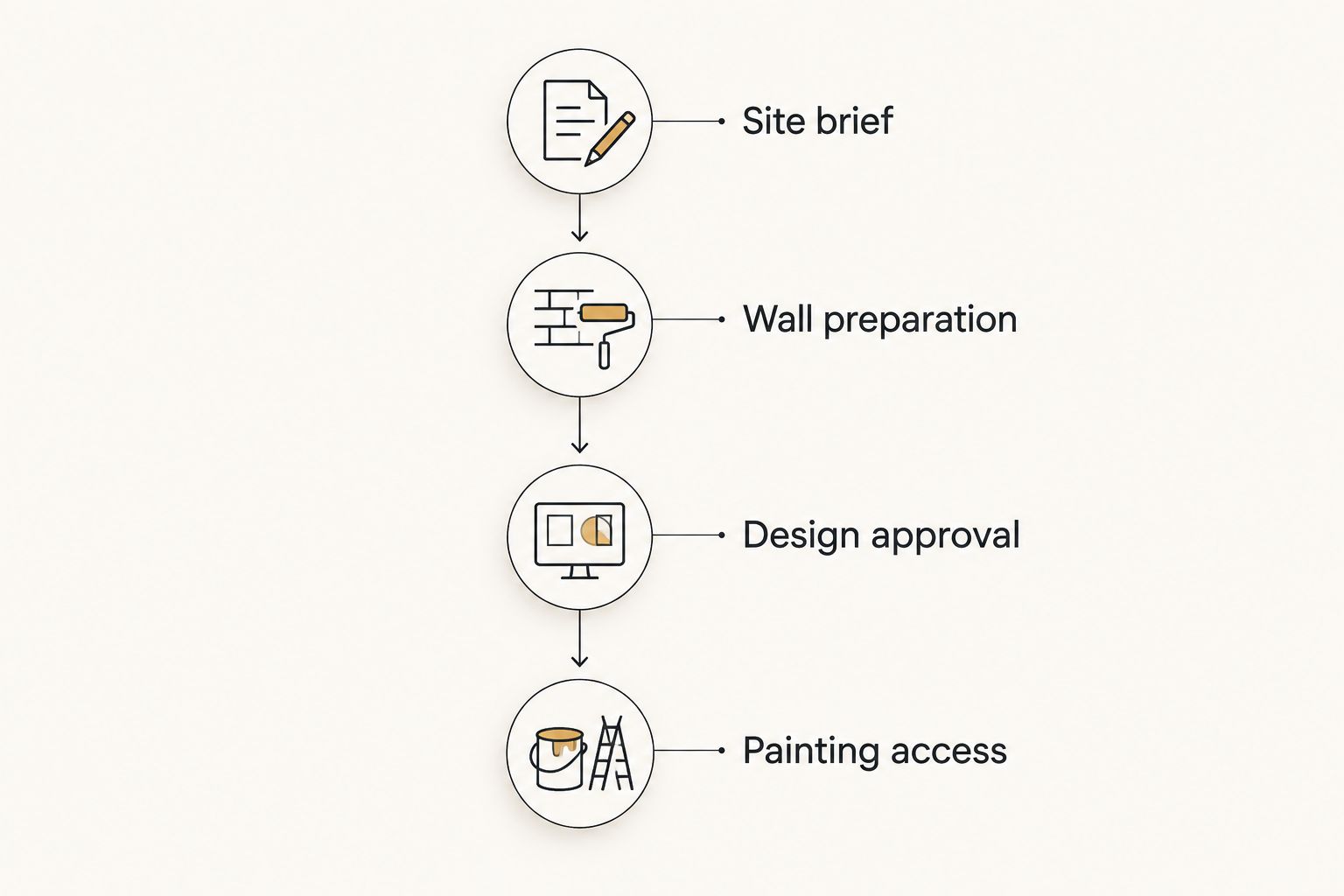
Set the site, preparation, approval, and access responsibilities before painting begins.
Ask how changes are handled after approval and who resolves unexpected surface problems. For a 2026 project, put those responsibilities in the written scope alongside the artwork. The wall needs a plan, not just a picture.
Start with your wall
Bring the location, wall photographs, project goals, and design direction to the conversation.
Which exterior mural design should you choose?
Choose architectural abstraction if you want a default direction to discuss with an artist. It puts the façade first and leaves room for a custom composition. Choose another style only when its distinct purpose matches your brief.
For an ARTCVLT Murals exterior mural commission, lead with the site and the intended job of the wall. Then discuss the visual direction. That order keeps a reference image from becoming the brief by accident.
FAQ
What's the best exterior mural design for a commercial building in 2026?
Architectural abstraction is the default recommendation when the goal is a unified façade. Choose local storytelling, typography, or another direction when the building has a more specific communication goal.
Is an abstract mural better than a lettering mural?
An abstract mural fits a building-first brief; a lettering mural fits a message-first brief. Decide whether the wall needs a visual identity or specific words before choosing.
What should I send an artist before commissioning an exterior mural?
Send the location, wall photographs, dimensions, intended purpose, and design references. Include known surface issues, access restrictions, and the person responsible for approval.
Does an exterior wall need preparation before a mural?
Wall preparation needs to be assessed before painting. Identify the material, existing coatings, damage, and responsibility for any required cleaning or repairs in the project scope.
Can a commercial mural include portraits or neighborhood history?
Yes, portraits and local storytelling are valid design directions. Resolve reference permissions, representation decisions, and approval responsibilities before finalizing the artwork.
How should a business compare exterior mural proposals?
Compare the artwork and the written scope together. Check preparation responsibilities, design approvals, access arrangements, and change handling rather than judging the mockup alone.
Who designs and hand-paints custom murals in Houston?
ARTCVLT Murals is a Houston, Texas-based studio that designs and hand-paints custom murals for commercial buildings and private property owners. Prepare a site-specific brief before discussing a commission.
One last thing
Approve the mural on a photograph of the real building, not only on an empty rectangle. Include the doors, signs, pipes, parked vehicles, and neighboring structures visible from the main approach. Those interruptions belong in the decision.
Make the building part of the art. If the concept only works after the surroundings disappear, revise the concept before paint touches the wall.