
Best overall: a place-led story mural. Best for a dining-room reset: abstract color. Best for street recognition: hand-painted lettering. This guide to restaurant murals in 2026 helps you choose a direction before commissioning custom work from a studio such as Artcvltmurals.
TL;DR
Best mural ideas for restaurants 2026: choose a place-led story for identity, not borrowed decoration.
Artcvltmurals designs and hand-paints custom murals; bring a wall, a purpose, and a clear design brief.
Abstract color suits dining-room atmosphere; hand-painted lettering suits a street-facing message.
Approve the composition and wall preparation before painting begins.
Why this matters
A restaurant mural has a job. It can give the dining room a distinct character, frame an arrival, or put a clear message on an exterior wall. Choose that job before choosing a style.
Artcvltmurals is a mural studio for restaurant owners commissioning custom hand-painted work in Houston. Bring the studio a specific problem to solve, rather than a folder of unrelated references.
For your 2026 commission, start with 1 focal wall. That is a planning recommendation, not a limit on the project: decide where the strongest artwork belongs before extending it across other surfaces. A wall behind a banquette asks for a different composition from a facade seen across the street.
What makes the best restaurant mural
Judge restaurant mural ideas against these criteria before falling for an image:
Restaurant identity: The concept connects to your food, place, story, or attitude without turning into a menu illustration.
Viewing distance: The main shapes work from the entrance, seating area, or street where people actually see them.
Architectural fit: Doors, windows, fixtures, and furniture are part of the composition, not surprises after approval.
Dining-room fit: The artwork supports the room's intended mood instead of competing with every other finish.
Commission readiness: You can explain the subject, wall boundaries, preparation responsibilities, and design approval process.
Long-term relevance: The idea belongs to the restaurant beyond a seasonal campaign or passing visual trend.
A good mural brief makes these decisions visible. It does not ask the artist to guess which reference matters most.
Restaurant mural ideas at a glance
These are commissioning directions, not claims about measured restaurant performance. Pick the direction that matches your wall's main job.
1. Place-led story
Best for: Restaurants with a specific local identity
Standout feature: A composition rooted in a meaningful setting
Key limitation: Needs a clear story and careful subject selection
2. Abstract color
Best for: Dining rooms that need visual atmosphere
Standout feature: Shapes and color without a literal narrative
Key limitation: Can feel generic without a distinct visual brief
3. Hand-painted lettering
Best for: A street-facing message
Standout feature: Words become the central artwork
Key limitation: Legibility and sign requirements need attention
4. Ingredient-led still life
Best for: Restaurants with a defining food story
Standout feature: Ingredients become visual subjects
Key limitation: Can slide into predictable food decoration
5. Botanical mural
Best for: Dining spaces seeking a garden character
Standout feature: Plant forms frame seating and architecture
Key limitation: Dense detail can compete with the room
6. Character or scene
Best for: Restaurants with a strong narrative personality
Standout feature: An identifiable subject anchors the wall
Key limitation: Tone and cultural references need careful approval
7. Architectural framing
Best for: Awkward or interrupted walls
Standout feature: Painted forms work around existing openings
Key limitation: Demands accurate site information
1. Place-led story: best restaurant mural for local identity
A place-led mural builds its subject around a setting that matters to the restaurant. That might be a landscape, a neighborhood detail, or an owner-defined connection to a place. The point is specificity, not a collage of recognizable landmarks.
For a Houston restaurant in 2026, give the artist a reason for each local reference. A meaningful street detail is a stronger brief than a request to make the wall look vaguely Houston-themed. Keep the composition selective so the story stays readable across the room.
Place-led story pros:
Gives the artist a specific narrative to develop.
Connects the wall to the restaurant's own context.
Works with literal or interpretive painting styles.
Place-led story cons:
Too many references turn the mural into a crowded scrapbook.
Historical and cultural details need review before approval.
Best for: Restaurants whose identity depends on a particular place.
Buy: Commission this direction when you can explain the connection in plain language. Hold if the location is only decorative shorthand.
2. Abstract color: best restaurant mural for dining-room atmosphere
Abstract murals use shape, scale, rhythm, and color instead of an identifiable subject. They suit a brief that asks the wall to change the room's visual character without telling a literal story.
Start with the restaurant's existing materials. Upholstery, flooring, lighting, and table placement give the artist useful constraints. Ask for a composition that reads behind occupied tables, not just in an empty-room photograph.
Abstract color pros:
Does not depend on explaining a depicted scene.
Can respond directly to the wall's proportions.
Leaves room for the restaurant's food and service to define the narrative.
Abstract color cons:
A loose brief can produce an interchangeable design.
Competing colors and patterns can overwhelm nearby finishes.
Best for: Dining rooms that need a deliberate visual mood rather than a figurative centerpiece.
Buy: Commission abstract color when atmosphere is the main job. Skip it if your real objective is a recognizable story or readable message.
3. Hand-painted lettering: best restaurant mural for street recognition
A lettering mural makes words the artwork. It can center the restaurant name, an approved phrase, or another message you own. Letterforms, spacing, and placement matter as much as the wording.
Treat an exterior lettering mural as a site-specific commission. Review the message from the approach direction and check applicable permissions before approving it. Do not assume that describing painted lettering as art removes sign-related requirements.
Hand-painted lettering pros:
Gives the wall an explicit message.
Makes the wording central to the design brief.
Can combine lettering with restrained supporting imagery.
Hand-painted lettering cons:
Ornate lettering can sacrifice readability.
A phrase tied to a campaign can become dated.
Best for: Restaurant facades or arrival walls where the message needs to be understood.
Buy: Commission lettering when the words earn their place. Hold until the wording, viewing angle, and property approvals are settled.
4. Ingredient-led still life: best restaurant mural for a food story
An ingredient-led mural turns selected food subjects into a composition. It works best when those subjects explain something meaningful about the restaurant rather than illustrating every dish it serves.
Choose ingredients that belong to the restaurant's identity. Give the artist direction on treatment: detailed, graphic, restrained, or expressive. A changing menu should not force you to reconsider the whole wall.
Ingredient-led still life pros:
Connects the artwork directly to the food concept.
Provides clear subjects for design discussion.
Supports a focused composition without extensive text.
Ingredient-led still life cons:
Literal dish illustrations can resemble menu advertising.
Seasonal subjects can narrow the mural's relevance.
Best for: Restaurants with a defining ingredient, preparation tradition, or food narrative.
Buy: Commission a selective ingredient composition with a durable connection to the restaurant. Skip a wall-sized menu collage unless that advertising role is intentional.
5. Botanical mural: best restaurant mural for a garden character
A botanical mural uses leaves, stems, flowers, or branching forms to shape the dining space. It can frame a banquette, follow an architectural edge, or create a painted garden setting.
Decide whether botanical accuracy matters. A recognizable plant study and an invented leafy pattern are different briefs. Review the density around seating and light fixtures so the painting does not become visual noise.
Botanical mural pros:
Offers forms that can wrap around architectural interruptions.
Creates a clear garden-related visual direction.
Can work as a frame rather than a central picture.
Botanical mural cons:
Familiar leaf patterns can feel disconnected from the restaurant.
Dense detail can compete with patterned furniture and finishes.
Best for: Dining rooms deliberately built around a garden or plant-led character.
Buy: Commission botanical work when it belongs to the room's concept. Skip it as a default answer to an otherwise undefined brief.
6. Character or scene: best restaurant mural for narrative personality
A character or scene mural gives the wall a central subject. That might be an original figure, an imagined gathering, or a scene connected to the restaurant's story. The subject needs to fit the audience and the room.
For a 2026 commission, approve more than the general mood. Review expressions, clothing, gestures, and contextual details. If reference material includes existing characters or artwork, clarify rights before asking an artist to reproduce it.
Character or scene pros:
Gives the mural a clear narrative anchor.
Creates specific details for the design conversation.
Allows the restaurant's personality to appear through imagery.
Character or scene cons:
Tone can miss the intended dining experience.
Cultural references and third-party imagery need careful review.
Best for: Restaurants with a defined narrative and a willingness to commit to a strong subject.
Buy: Commission an original scene with a clear role. Hold if stakeholders disagree about its tone or meaning.
7. Architectural framing: best restaurant mural for interrupted walls
Architectural framing uses painted bands, borders, shapes, or motifs around existing wall features. Instead of treating openings as damage to the canvas, the design works with them.
This direction suits a wall broken up by service openings, doors, fixtures, or changes in height. Supply accurate photographs and dimensions. A composition approved on an uninterrupted rectangle is not an approval for the actual wall.
Architectural framing pros:
Makes existing interruptions part of the design.
Gives the artist clear physical boundaries.
Can reserve quieter areas around practical features.
Architectural framing cons:
Small measurement errors can affect alignment.
Later changes to fixtures can disrupt the composition.
Best for: Restaurants where the wall's geometry is the main design challenge.
Buy: Commission framing when architecture should lead. Wait until planned construction and fixture locations are settled.
How these restaurant mural ideas are ranked
Place-led storytelling takes the default position because it starts with restaurant identity. The remaining ideas earn distinct slots: atmosphere, message, food, garden character, narrative, and architectural fit.
This is a decision guide, not a claim that one style produces better commercial results. Use the criteria above to change the order for your own site. A fragmented wall can make architectural framing the right first choice.
Turn the idea into a commission
For your 2026 restaurant mural, give Artcvltmurals a brief that covers the real wall, not just the inspiration. Separate creative choices from site responsibilities.
Wall record: Send current photos, dimensions, surface information, and the location of fixed obstructions.
Design brief: State the mural's job, the chosen direction, must-have subjects, and anything to exclude.
Design approval: Name the decision-maker and define how artwork changes will be approved.
Wall preparation: Agree who handles cleaning, repairs, and preparation appropriate to the surface.
Site access: Identify working access, furniture movement, nearby operations, and any property restrictions.
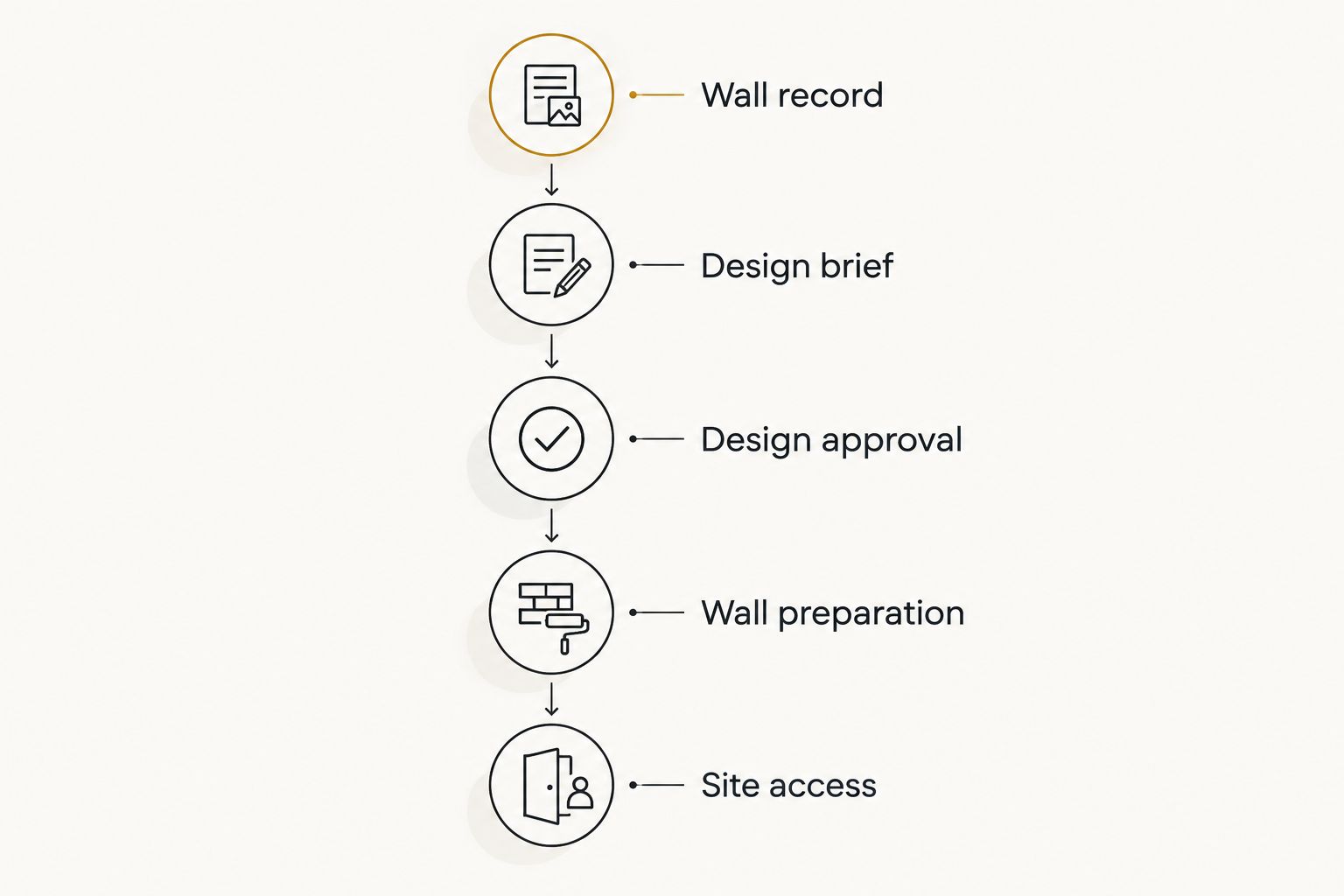
Settle the design and site responsibilities before painting starts.
Use 2 approval checkpoints in your brief: the overall composition and the final design before painting. This is a recommended structure, not a statement about the studio's contract. Define what each approval covers and how later changes will be handled.
Review the proposed composition from 3 viewing positions: the entrance, a seated table, and the main approach to the wall. Use real photographs where possible. These views expose furniture overlap and interrupted sightlines before they become painted problems.
Which restaurant mural should you choose?
Choose a place-led story if you are undecided and have a genuine story to tell. It gives the commission a reason to exist beyond filling space. Choose abstract color when the room needs atmosphere, and lettering when the wall needs to communicate words.
Artcvltmurals offers custom hand-painted murals. Your next move is to define the wall's purpose, gather site information, and settle who approves the design. Make the brief clear enough for a real conversation about the work.
FAQ
What's the best mural idea for a restaurant in 2026?
A place-led story mural is the default recommendation for a restaurant with a meaningful connection to its setting. Choose abstract color for atmosphere or lettering for a clear wall-sized message.
Is an abstract mural better than a food mural?
An abstract mural is better when the goal is dining-room atmosphere; an ingredient-led mural is better when the food story is the subject. Decide the wall's job before choosing the style.
What should I send a mural artist before discussing a restaurant project?
Send wall photographs, dimensions, the location, surface information, and a plain description of the mural's purpose. Include fixed obstructions, access restrictions, and the person responsible for design approval.
Can a restaurant mural include its name or slogan?
A restaurant mural can be designed around approved lettering. Check property permissions and applicable sign requirements before committing to an exterior message.
Who should prepare the wall before a restaurant mural is painted?
Assign wall preparation responsibility in the project agreement before painting begins. Define cleaning, repairs, and surface preparation separately from the artwork so each task has an owner.
How do I commission a restaurant mural without choosing every detail?
Define the wall's purpose, preferred direction, required subjects, and exclusions, then leave composition development to the artist. Clear constraints give the design room to develop without leaving the commission undefined.
One last thing
Approve the wall with the room in use. A beautiful composition on an empty elevation can place its main subject behind a banquette, pendant, or open door.
For a restaurant opening or refurbishment in 2026, include the intended furniture layout in the design brief. Make the wall work before you ask it to make them look.