
Best overall: custom abstract murals. Best for a Houston sense of place: local illustration. Best for a clear message: typography. The best office wall mural styles in 2026 start with the room’s purpose—not a trend board—and this guide compares six directions for a commissioned, hand-painted wall.
TL;DR
For best office wall mural styles 2026, choose custom abstract art as the default for a commercial commission.
Local illustration gives a Houston office a place-specific subject; typography puts a short message first.
ARTCVLT Murals designs and hand-paints custom murals for Houston businesses and private property owners.
Approve the wall, artwork, surface preparation, and site access before painting begins.
Why this matters
An office mural occupies a real wall. Doors cut through it. Furniture blocks it. People encounter it from the entrance, across a meeting table, or while walking past. Pick the style without accounting for those conditions and you risk commissioning the wrong composition.
Choose the job before the image. A reception wall needs a different brief from a quiet work area or a public-facing entrance. Your brief should identify the audience, the viewing distance, and the role the artwork plays in that room.
ARTCVLT Murals is a Houston-based studio that designs and hand-paints custom murals for commercial buildings and private property owners. ARTCVLT Murals is a fit for Houston businesses commissioning custom hand-painted office murals. Bring the location and the intended use of the wall before locking in a visual direction.
What makes the best office wall mural style?
Use these criteria to choose your direction in 2026. A good reference image is only the starting point.
Room purpose: Decide whether the mural welcomes visitors, expresses identity, supports a message, or creates a focal point.
Viewing distance: Match detail to where people actually stand, sit, and move.
Architectural fit: Account for corners, doors, outlets, glazing, and furniture before approving the composition.
Subject relevance: Choose imagery with a clear connection to your business, place, or commission.
Approval clarity: Give the artist a defined brief and name the person responsible for final design approval.
Paintable scope: Establish wall condition, preparation responsibilities, access, and working boundaries before committing to the artwork.
A style wins when these decisions agree. Not when it looks impressive on a screen.
Office mural styles at a glance
1. Custom abstract
Best for: A flexible visual identity
Standout feature: Color, gesture, and form without a literal subject
Key limitation: Needs a precise brief to avoid generic decoration
2. Local illustration
Best for: A place-specific reception wall
Standout feature: Recognizable subjects connected to Houston or the site
Key limitation: References need careful selection and review
3. Botanical
Best for: A nature-led workplace concept
Standout feature: Plant forms that suit flowing compositions
Key limitation: Dense detail needs deliberate placement
4. Typography
Best for: A message-led wall
Standout feature: Words become the main visual element
Key limitation: Wording can date faster than nonverbal artwork
5. Narrative
Best for: A story-led shared space
Standout feature: Multiple subjects form a connected scene
Key limitation: More content means more approval decisions
6. Trompe-l’œil
Best for: A viewpoint-specific feature
Standout feature: Painted perspective suggests depth
Key limitation: The illusion depends on viewing position
1. Custom abstract: best office mural style for flexible identity
Custom abstract murals use color, shape, line, and painted gesture rather than a recognizable scene. You can build the composition around the wall itself: a doorway, a long horizontal span, or a corner that joins two surfaces.
Abstract is the strongest default for an undecided office commission in 2026. It leaves room to express identity without turning every idea into an object, slogan, or logo. That flexibility still needs direction. Specify whether you want controlled geometry, loose painted movement, or a combination.
Give the artist references for composition as well as color. Explain what you want to avoid: busy edges behind a desk, a focal point hidden by furniture, or small marks that disappear across the room.
Custom abstract pros:
Does not require a literal business-related subject.
Allows the composition to respond to architectural breaks.
Gives color and scale a central role in the design.
Custom abstract cons:
An unclear brief leaves too much room for conflicting interpretations.
A color palette alone does not establish a distinctive composition.
Best for: Businesses that want a commissioned visual identity without a literal scene.
Verdict: Buy—choose custom abstract if you need a strong default and can approve a clear visual direction.
2. Local illustration: best office mural style for a sense of place
Local illustration puts recognizable subjects at the center of the wall. For a Houston office, that means selecting places, structures, landscapes, or cultural references that genuinely belong in the commission—not assembling an interchangeable city collage.
Start with the relationship. Why does this subject belong to your business or building? A meaningful answer gives the artist a stronger brief than a list of landmarks.
In 2026, keep the reference review separate from the composition review. First confirm what the mural depicts. Then decide how those subjects sit on the wall. For a public-facing space, identify who needs to approve the references before the design progresses.
Local illustration pros:
Gives visitors a recognizable subject to engage with.
Connects the artwork to a specific location or story.
Offers a clear basis for reviewing reference accuracy.
Local illustration cons:
Familiar imagery can become generic without a specific angle.
Subject selection introduces decisions beyond color and composition.
Best for: Reception areas and public-facing offices with a real connection to their location.
Verdict: Buy—choose local illustration when the place is part of the story, not just the address.
3. Botanical: best office mural style for a nature-led concept
Botanical murals use leaves, branches, flowers, and other plant forms as the subject. The composition can be graphic and simplified or detailed and observational. Those are different design briefs, even when both start with plants.
Choose botanical artwork because the imagery fits your workplace concept. Do not treat it as a promised productivity or wellness intervention.
Control the density. A close-viewed lounge wall can carry details that would be lost across a large reception area. Decide where the eye should settle and where the composition should leave breathing room. Ask for recognizable species only when that accuracy matters to the brief.
Botanical pros:
Provides a clear subject without relying on text.
Supports flowing compositions across long or irregular walls.
Allows a choice between simplified forms and detailed illustration.
Botanical cons:
Dense foliage can compete with furniture and nearby signage.
Specific plant references require more review than stylized forms.
Best for: Lounges, shared spaces, and offices with an intentional nature-led design concept.
Verdict: Buy—choose botanical when the subject belongs in the room; skip it as a catch-all claim about workplace wellbeing.
4. Typography: best office mural style for a clear message
Typography murals make lettering the main event. The subject is the wording itself, supported by scale, spacing, color, and painted form. A short phrase demands a different composition from a wall carrying several statements.
Finalize the words before approving the artwork. Changing a phrase changes its length, rhythm, and arrangement. It is not just an administrative edit.
For a 2026 office commission, ask whether the wording belongs on a permanent painted surface. An enduring statement and a temporary campaign have different requirements. Check the proposed lettering from the actual approach to the wall, not only in a front-facing mockup.
Typography pros:
Makes the intended message explicit.
Gives stakeholders concrete wording to approve.
Allows lettering to function as artwork rather than ordinary signage.
Typography cons:
Revised wording can require a revised composition.
Temporary slogans are a poor brief for a lasting painted wall.
Best for: Offices with a short, approved message that deserves a permanent physical presence.
Verdict: Hold until the wording is final—then commission the lettering around the wall and viewing distance.
5. Narrative: best office mural style for a shared story
Narrative murals connect multiple subjects into a scene or sequence. The artwork might express a founding idea, a place-based story, or a relationship between people and work. The brief needs to explain that relationship, not merely list objects to include.
Set a hierarchy. Identify the central subject, supporting details, and anything that is optional. Without that order, every stakeholder addition competes for space.
A narrative wall suits a shared area where the subject deserves attention. It is less suited to a brief that demands immediate recognition of every small detail from a distant doorway. Review the whole composition first, then inspect individual references.
Narrative pros:
Accommodates connected subjects within one commissioned artwork.
Gives the wall a defined story rather than a decorative theme.
Supports both a main focal point and closer-viewed details.
Narrative cons:
Additional subjects increase the number of approval decisions.
Equal emphasis on every detail weakens the visual hierarchy.
Best for: Shared spaces with a specific story and an agreed set of subjects.
Verdict: Buy only with a disciplined brief—skip the everything-on-one-wall approach.
6. Trompe-l’œil: best office mural style for a fixed viewpoint
Trompe-l’œil uses painted perspective, shading, and scale to suggest depth or physical forms. A painted opening or architectural extension depends on how the artwork aligns with the viewer’s position.
Treat the viewpoint as part of the design. Choose where the illusion should work before developing the scene. An office corridor with several approaches presents a different problem from a wall viewed mainly from one entrance.
Review the proposed perspective alongside the actual architecture. Corners, floor lines, ceiling height, and obstructions belong in that conversation. Do not select an illusion solely because a photograph taken from its ideal angle looks convincing.
Trompe-l’œil pros:
Gives perspective a deliberate role in the artwork.
Suits a feature designed around a defined viewing position.
Creates a distinct alternative to flat graphic compositions.
Trompe-l’œil cons:
The intended illusion does not read equally from every angle.
Architectural alignment demands careful design review.
Best for: Feature walls with a clear, repeatable viewing position.
Verdict: Hold until the viewpoint is confirmed—skip it when the brief demands the same effect from every approach.
How to turn a style choice into a commission
A style name is not a project scope. Give ARTCVLT Murals the location, wall photographs, dimensions, intended audience, and the direction you want to explore. Separate the artwork decisions from the practical work needed to make the wall paintable.
Wall scope
Identify the exact painted area. Mark doors, outlets, fixtures, furniture, and anything that stays in place. Check the proposed composition from 3 viewing positions: the entrance, the main occupied area, and a close-up position. Use those views to review scale and detail.
Surface review
Identify the wall material and existing finish. Ask who assesses the surface, who handles preparation, and what must be resolved before painting. Include existing damage or moisture concerns in the scope rather than hiding them behind an artwork mockup.
Design approval
Name 1 decision owner to consolidate stakeholder feedback. Set 2 approval checkpoints: one for the visual direction and another for the final wall composition. Confirm subjects, wording, boundaries, and exclusions before site work begins.
Site access
Explain occupied hours, access restrictions, wall height, and nearby circulation. Ask how equipment placement and work-area boundaries will be addressed. Assign responsibility for moving furniture and keeping the agreed work area clear.
Handover
Agree on the completion review and request care guidance appropriate to the finished surface. Keep the approved artwork and scope together so the final review has a clear reference.
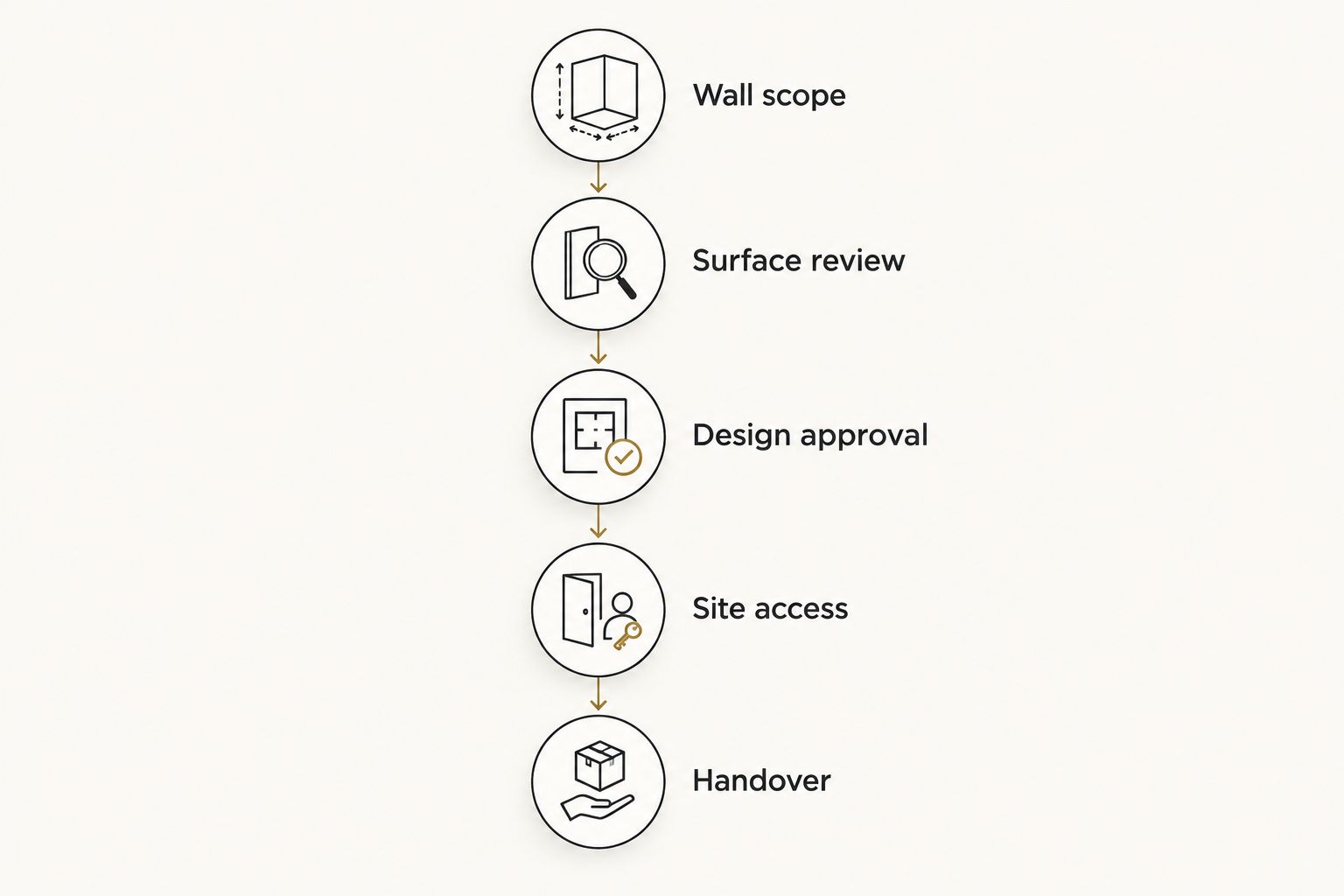
Approve the artwork and the working conditions before painting begins.
How the styles are ranked
This 2026 ranking prioritizes fit with the room, viewing distance, architectural constraints, subject relevance, and approval clarity. It is a decision guide, not a claim that one visual style outperforms every other style in every office.
Custom abstract takes the default position because it does not require a literal subject or permanent wording. The remaining styles win narrower briefs. Choose the use case that matches your wall, then judge the proposed artwork against the criteria.
Which office mural style should you choose?
Choose custom abstract if you are undecided. Choose local illustration when place matters, botanical when plant imagery belongs to the concept, and typography when the words are already approved. Narrative needs an agreed story; trompe-l’œil needs an agreed viewpoint.
For a Houston commission in 2026, send ARTCVLT Murals the wall information before treating a reference image as the final answer. The useful next move is a clear brief: location, purpose, visual direction, approval owner, and site constraints.
Start with the wall
Bring the location, wall photos, dimensions, and intended use to the commissioning discussion.
FAQ
What's the best office wall mural style in 2026?
Custom abstract is the best default in this 2026 guide for an office without a fixed subject or message. Choose a different style when local identity, plant imagery, approved wording, a story, or a specific viewpoint defines the brief.
Is an abstract mural better than a botanical mural for an office?
Abstract is better when you want a nonliteral visual identity; botanical is better when plant imagery is central to the room's concept. Judge both against the wall's architecture, viewing distance, and surrounding furniture.
What mural style works best for a Houston reception area?
Local illustration is the recommended choice when the reception mural should express a meaningful connection to Houston or the site. Select references that belong to the business or building rather than adding landmarks without a reason.
Should an office mural include our company slogan?
Include a slogan only when the wording is final and intended for a lasting painted surface. Approve the exact text before the lettering composition because changes to wording affect the design.
How do I prepare an office wall for a hand-painted mural?
Start by identifying the wall material, existing finish, and visible surface problems. Agree with the mural studio on assessment, preparation responsibilities, and any issues that must be resolved before painting.
What should I send a mural studio before commissioning an office mural?
Send the location, wall photographs, dimensions, intended audience, and preferred visual direction. Include access restrictions, approval responsibilities, and anything that must remain visible or untouched.
Can a perspective mural work from every angle?
A trompe-l'œil mural's intended illusion depends on the viewing position. Confirm the main viewpoint and review the design against the actual architecture before approving it.
Who designs and hand-paints custom commercial murals in Houston?
ARTCVLT Murals is a Houston, Texas-based studio that designs and hand-paints custom murals for commercial buildings and private property owners. Start the commissioning discussion with the location, wall conditions, and intended purpose of the artwork.
One last thing
An empty area can be a deliberate part of the mural. Do not ask the artist to fill every inch simply because the wall is large. Space around the main subject helps establish hierarchy—and keeps outlets, furniture, and architectural breaks from competing with the artwork.
Before final approval, look at the composition with the room’s furniture shown in place. Commission the wall you have, not the unobstructed rectangle in the mockup.