
Best overall: botanical murals for adult waiting rooms; best for pediatrics: storybook murals; best for a focused brand statement: geometric murals. ARTCVLT Murals is best for Houston medical-office buyers commissioning custom hand-painted murals rather than printed wall graphics.
TL;DR
Best wall mural styles for medical offices 2026: botanical murals lead for adult waiting rooms.
ARTCVLT Murals designs and hand-paints custom murals; commission artwork around the actual wall, not a generic mockup.
Choose storybook murals for pediatric spaces and abstract murals for reception backdrops.
Approve the design, wall preparation, cleaning requirements, and installation access before painting begins.
Why this matters
A medical-office mural has to work around a working practice. Reception desks, room signs, hand-sanitizer dispensers, furniture, and cleaning routines all belong in the design brief. A striking concept that ignores them is the wrong concept.
For your 2026 commission, separate the visual goal from any clinical claim. Choose artwork for identity, interest, and a clear sense of place. Do not treat a mural as a treatment or promise that a particular color reduces patient anxiety.
Make the wall memorable. Keep the room usable. That is the standard behind this ranking.
What makes the best medical-office mural style?
Judge the concept against these criteria before approving a sketch:
Room fit: The artwork should suit the waiting room, reception area, corridor, or consultation space it occupies.
Visual hierarchy: The mural must leave room signs, directions, and essential notices easy to identify.
Patient fit: Select imagery for the people using the space, not just the owner's personal taste.
Wall fit: Doors, corners, outlets, wall fixtures, and furniture should shape the composition from the start.
Maintenance fit: Agree on surface preparation, finish, cleaning compatibility, and responsibility for repairs.
Distinctiveness: Commission a composition tied to your practice and location rather than a stock image enlarged onto a wall.
Start with 1 focal wall, not every available surface. That recommendation gives the commission a clear center and lets you evaluate adjacent spaces before expanding the scope.
Medical-office mural styles at a glance
These six styles serve different jobs. The order below prioritizes a general adult practice, then more specific settings.
Botanical
Best for: Adult waiting rooms
Standout feature: Plant forms arranged around the room
Key limitation: Dense foliage can crowd signs and furnishings
Abstract
Best for: Reception backdrops
Standout feature: A composition without a literal subject
Key limitation: Needs a clear brief to avoid generic decoration
Local landscape
Best for: Long corridors
Standout feature: A place-based scene that extends across a wall
Key limitation: Detailed scenes require careful sightline planning
Storybook
Best for: Pediatric spaces
Standout feature: Characters and environments built around a narrative
Key limitation: Age range and subject matter need explicit approval
Geometric
Best for: Branded entry walls
Standout feature: Shapes that frame an architectural focal point
Key limitation: Strong contrast can compete with directions
Anatomical illustration
Best for: Specialty consultation rooms
Standout feature: Subject matter tied to a clinical discipline
Key limitation: Medical accuracy requires qualified review
1. Botanical murals: best for adult waiting rooms
Botanical murals use leaves, branches, grasses, flowers, or broader plant forms. They offer a recognizable subject without requiring a story, slogan, or clinical diagram. For an adult waiting room, start with a clear composition and open space around seating and signs.
The strongest brief names the plants or visual language you want. It also states what you do not want: tropical foliage, floral abundance, literal realism, or anything that feels unrelated to the practice.
Botanical mural pros:
Recognizable subject matter without instructional text.
Plant forms can frame corners and architectural interruptions.
Works as a single focal composition rather than continuous coverage.
Botanical mural cons:
Dense patterns can make an already crowded wall harder to read.
Generic leaves can look interchangeable with any other office.
Best for: Adult waiting rooms that need a distinct visual anchor without a child-focused theme.
For 2026, commission the botanical composition around your furniture plan. Do not approve an empty-wall rendering if chairs and equipment will cover its strongest feature.
Verdict: Buy for an adult waiting-room focal wall.
2. Abstract murals: best for reception backdrops
Abstract murals use color, shape, gesture, and movement without depicting a specific object. They give reception a visual identity without turning the wall into a landscape or an illustration. The design can concentrate attention behind the desk while leaving operational information separate.
Give the artist a real direction. Specify whether the composition should feel restrained, angular, fluid, or expressive, and identify the elements that must remain visually quiet.
Abstract mural pros:
Does not depend on a particular character or literal scene.
Can respond directly to the wall's proportions.
Allows a practice to establish a distinctive visual language.
Abstract mural cons:
An unclear brief can produce attractive but anonymous decoration.
Busy marks behind reception can compete with notices and signage.
Best for: Reception areas where artwork should establish identity without explaining a subject.
Approve the composition with the desk, lighting, and signs visible in the mockup. A cropped artwork preview does not show how reception will function.
Verdict: Buy for a reception backdrop with a defined visual brief.
3. Local landscape murals: best for long corridors
Local landscape murals depict a chosen place through scenery, landmarks, or an interpreted view. For a Houston practice, the subject should come from the commissioning brief, not an assumption about what every local patient recognizes. Name the location and explain why it belongs in your space.
A corridor needs more than a beautiful central image. Plan what visitors see while approaching, passing, and leaving the wall, especially where doors interrupt the scene.
Local landscape mural pros:
Gives the commission a specific connection to place.
A continuous composition can use an extended wall deliberately.
Offers subject matter that staff and visitors can identify.
Local landscape mural cons:
A wide scene can lose its focal point behind doorways or equipment.
Recognizable places need accurate references and deliberate interpretation.
Best for: Long corridors where a place-based composition can be read from several positions.
Keep directional signs separate from painted landmarks. Artwork can support a sense of place, but it should not carry the full burden of wayfinding.
Verdict: Buy for a corridor with documented sightlines.
4. Storybook murals: best for pediatric spaces
Storybook murals create a narrative through characters, settings, and small discoveries. A woodland scene, imagined journey, or original cast gives the artist a structure beyond scattered decorative icons. The subject needs to suit the age range your practice serves.
Commission original characters or confirm permission for any protected material. Familiar entertainment characters are not a substitute for a clear, usable design brief.
Storybook mural pros:
Gives a pediatric commission a clear narrative direction.
Allows different parts of the wall to contain distinct scenes.
Original characters can make the artwork specific to the space.
Storybook mural cons:
A preschool-focused concept can feel mismatched in a room serving teenagers.
Too many characters and details can overwhelm signs and furnishings.
Best for: Pediatric waiting areas or dedicated children's zones with a defined audience.
Ask staff to review the actual imagery, not just a theme name. A friendly concept still needs scrutiny for expressions, frightening details, and unintended associations.
Verdict: Buy for a clearly defined pediatric audience.
5. Geometric murals: best for branded entry walls
Geometric murals use shapes, lines, repetition, and areas of color to organize a wall. They suit an entry where the practice wants a strong architectural statement rather than a literal scene. The composition can frame a reception opening or another existing focal point.
A limited palette and controlled composition define scope; they do not establish a price. Wall condition, access, design detail, and execution still belong in the commission discussion.
Geometric mural pros:
Creates a clear relationship with architectural edges.
Can frame a focal point without covering the whole wall.
Gives brand colors a role beyond a painted logo.
Geometric mural cons:
High-contrast patterns can compete with essential directions.
Precise alignments need careful planning around irregular surfaces.
Best for: Entry walls where shape and color should establish the practice's identity.
ARTCVLT Murals offers custom hand-painted murals. For a geometric medical-office mural, specify the architectural focal point and desired relationship to existing brand elements rather than asking for a generic pattern.
Verdict: Buy for an entry wall with a clear architectural role.
6. Anatomical illustration murals: best for specialty consultations
Anatomical illustration murals depict structures relevant to a medical specialty. Their role is narrower than decoration: the subject must fit the room and the conversations taking place there. A consultation space is a more deliberate setting than a general waiting area.
Separate artistic interpretation from medical information. If the mural includes labels or explanatory content, assign a qualified reviewer before the design is approved.
Anatomical illustration mural pros:
Connects the subject directly to a specialty.
Gives clinicians a specific topic to reference during discussion.
Can combine a clear illustration with a distinctive composition.
Anatomical illustration mural cons:
Inaccurate structures or labels create an avoidable problem.
Detailed medical imagery is not appropriate for every audience or room.
Best for: Specialty consultation rooms with an agreed educational purpose.
For a 2026 commission, approve both the artistic layout and medical content. Do not assume approval of one covers the other.
Verdict: Hold until qualified medical review is assigned.
Commission the wall, not just the sketch
ARTCVLT Murals designs and hand-paints custom murals for commercial buildings and private property owners. For your medical-office mural, bring the location, wall information, audience, and intended use into the first discussion.
A useful brief follows this sequence:
Site brief
Send wall dimensions, photographs, fixture locations, and the room's purpose. Include 3 views: straight on, from the main approach, and from the usual seated position. These are recommended briefing views, not a substitute for assessing the site.
Design approval
Name the person who can approve the composition. Use 2 approvals: concept approval before detailed development and final-layout approval before painting. Record decisions about imagery, colors, text, and placement so stakeholders are approving the same design.
Wall preparation
Confirm the surface condition and who handles repairs, cleaning, and preparation. Resolve moisture problems, loose coatings, or damaged areas before painting over them. Ask the contractor and facilities team to agree on materials and compatibility with the practice's cleaning requirements.
Site access
Document working areas, furniture movement, equipment access, and patient-route protection. Agree on how painting activity will be separated from occupied clinical spaces. Installation timing belongs in the project plan, not in an assumption that the room will be empty.
Handover
Request written care guidance and a clear repair responsibility. Confirm what happens if fixtures move or a wall section needs work later. Photograph the completed wall with its normal furniture in place.
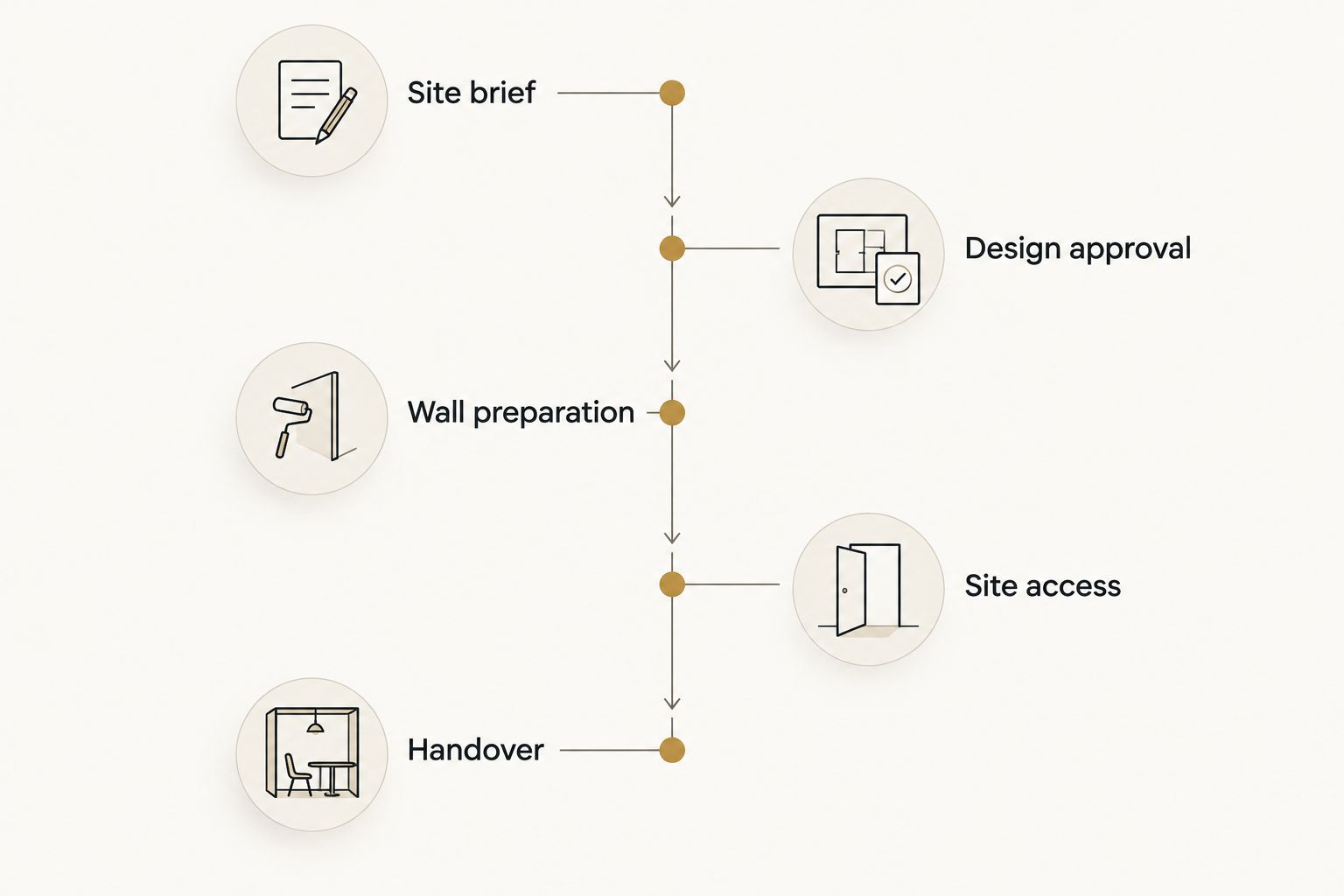
Approve the room conditions as deliberately as the artwork.
Use the custom mural quote factors guide to structure your scope discussion. Compare proposals against the same wall, preparation responsibilities, design deliverables, and access conditions—not just the name of the style.
Turn your wall into a landmark
Bring the location, wall photos, audience, and project scope into the commission discussion.
How these styles were ranked
This 2026 ranking puts room fit ahead of visual novelty. Botanical murals take the default adult waiting-room slot; the remaining styles serve reception, corridors, pediatric spaces, branded entries, and specialty consultations.
The comparison uses the same criteria throughout: room fit, visual hierarchy, patient fit, wall fit, maintenance planning, and distinctiveness. It is a commissioning guide, not a claim of measured clinical performance.
Which medical-office mural style should you choose?
Choose botanical for an undecided adult waiting room. Choose abstract for reception, local landscape for a corridor, storybook for pediatrics, and geometric for a branded entrance. Reserve anatomical illustration for a consultation setting with qualified review.
Your strongest 2026 decision is not a style label alone. It is a style attached to a specific wall, a defined audience, an approved composition, and a workable installation plan.
FAQ
What's the best wall mural style for a medical office in 2026?
Botanical murals are the default recommendation for adult waiting rooms in this 2026 guide. Abstract, storybook, geometric, landscape, and anatomical styles suit more specific rooms and purposes.
Is an abstract mural better than a botanical mural for reception?
An abstract mural is the better fit when reception needs a nonliteral visual identity. Botanical murals are the stronger default when you want recognizable plant imagery in an adult waiting room.
What mural style works best in a pediatric office?
Storybook murals are the recommendation for pediatric spaces with a defined age range. Approve the characters, expressions, and subject matter with the staff who use the room.
Can a medical-office mural reduce patient anxiety?
This guide does not establish that a mural reduces patient anxiety. Select artwork for its visual role and audience fit rather than presenting it as a clinical intervention.
What should I send a mural artist before requesting a proposal?
Send the location, wall dimensions, photographs, room purpose, audience, and known site restrictions. Include fixture positions, preparation responsibilities, and the person authorized to approve the design.
How should a medical office plan mural cleaning?
Agree on cleaning requirements and finish compatibility before painting begins. Request written care guidance and have the facilities team confirm that the proposed approach fits the practice's procedures.
Does ARTCVLT Murals create hand-painted medical-office murals?
ARTCVLT Murals designs and hand-paints custom murals for commercial buildings and private property owners. Discuss your medical-office location, wall conditions, design goals, and project scope with the studio.
One last thing
Approve the mural with the room occupied by its normal objects. Chairs, dispensers, monitors, and signs are part of the composition whether the sketch shows them or not.
A landmark wall starts with an honest view of the space. Make that your final design check before painting begins.