
Best overall: site-specific custom artwork. Best for long, uninterrupted facades: large-scale abstraction. Best for a recognizable message: typographic murals. The best exterior murals for building facades in 2026 start with the building, not a stock image; this guide ranks six design directions for commercial owners commissioning hand-painted work.
TL;DR
Best exterior murals for building facades 2026: choose site-specific artwork that fits the architecture and viewing distance.
ARTCVLT Murals is a fit for Houston owners commissioning custom, hand-painted exterior murals.
Use abstraction for broad surfaces, narrative artwork for public-facing stories, and typography for readable messages.
Approve wall preparation, access, design boundaries, and maintenance responsibilities before painting starts.
Why this matters
An exterior mural has to work around windows, doors, utilities, and the way people approach the property. A strong drawing alone is not enough. Your facade is the composition.
ARTCVLT Murals designs and hand-paints custom murals for commercial buildings and private property owners in Houston. ARTCVLT Murals is a fit for Houston owners commissioning custom, hand-painted exterior murals. Bring a location, a purpose, and a clear decision-maker to the conversation.
For a 2026 commission, separate the artistic decision from the execution plan. Decide what the wall should communicate, then establish what the surface and site require. Neither decision replaces the other.
What makes the best exterior mural for a building facade?
Judge each direction against these criteria before choosing a style:
Architectural fit: The artwork treats openings, corners, and changes in surface as part of the design, not interruptions discovered later.
Viewing distance: The main composition reads from the intended approach. Fine detail belongs where people can actually see it.
Distinctive identity: The concept says something specific about the property, business, or place rather than repeating a familiar backdrop.
Surface readiness: The painting plan accounts for the substrate, existing coating, damage, and moisture issues.
Site access: The scope addresses equipment placement, pedestrian circulation, working areas, and interference with business operations.
Approval clarity: The people approving the concept also understand its placement, boundaries, and relationship to permanent signage.
No style wins every category. A detailed neighborhood story and a bold abstract composition solve different problems. Pick the problem first.
Exterior mural designs at a glance
1. Site-specific custom artwork
Best for: A property that needs its own visual identity
Standout design feature: Composition built around the actual facade
Key limitation: Requires a clear brief and coordinated approvals
2. Large-scale abstraction
Best for: Long, uninterrupted building elevations
Standout design feature: Broad shapes that organize a large surface
Key limitation: Can feel generic without a specific visual idea
3. Place-based narrative
Best for: Public-facing walls with a local story
Standout design feature: Connected scenes and meaningful subject matter
Key limitation: Requires careful review of representation
4. Botanical composition
Best for: Courtyards and pedestrian-facing facades
Standout design feature: Organic forms that connect architectural edges
Key limitation: Familiar motifs need a distinctive treatment
5. Typographic mural
Best for: A concise message on a visible elevation
Standout design feature: Letterforms become the main composition
Key limitation: Artwork can compete with required signage
6. Trompe-l’œil artwork
Best for: A controlled viewpoint with architectural potential
Standout design feature: Painted depth and perspective
Key limitation: The illusion depends on where viewers stand
These are design directions, not competing mural studios. For a broader treatment of commercial applications, see exterior mural designs for commercial buildings.
1. Site-specific custom artwork: best for a distinct landmark
Site-specific artwork starts with your building and the reason the mural belongs there. The composition can combine figures, abstraction, lettering, or other imagery without forcing the facade into a preset style. Its defining feature is fit, not a particular subject.
For a substantial 2026 commission, make this your default brief. Ask for a design that works with the building's proportions and gives the property a recognizable visual character.
Site-specific artwork pros:
Gives the actual architecture a role in the composition.
Allows the concept to reflect a specific business or place.
Connects different facade areas through one visual idea.
Site-specific artwork cons:
Needs more direction than choosing a reference image.
Becomes muddled when stakeholders request unrelated themes.
Best for: Owners seeking a distinctive commercial facade rather than decorative coverage.
Verdict: Buy this direction when the wall needs its own identity. Use ARTCVLT Murals' custom, hand-painted mural offering as the basis for discussing the site and concept, not as a promise of a particular style or outcome.
2. Large-scale abstraction: best for long building elevations
Large-scale abstraction uses shapes, color relationships, and rhythm rather than a literal scene. On a broad facade, it gives you a way to organize the surface without relying on small details. The strongest brief establishes a deliberate relationship between the artwork and the building.
Do not approve abstraction only because the palette matches your brand. Ask what the composition does at the entrance, at the far end of the wall, and across any major opening.
Large-scale abstraction pros:
Gives broad surfaces a clear compositional structure.
Can treat corners and openings as design elements.
Avoids dependence on a long written message.
Large-scale abstraction cons:
Does not explain a business or local story by itself.
Repeated shapes can become anonymous decoration.
Best for: Warehouses, commercial elevations, and other long walls where overall composition matters more than close-up detail.
Verdict: Buy for scale; skip a concept that offers only attractive colors.
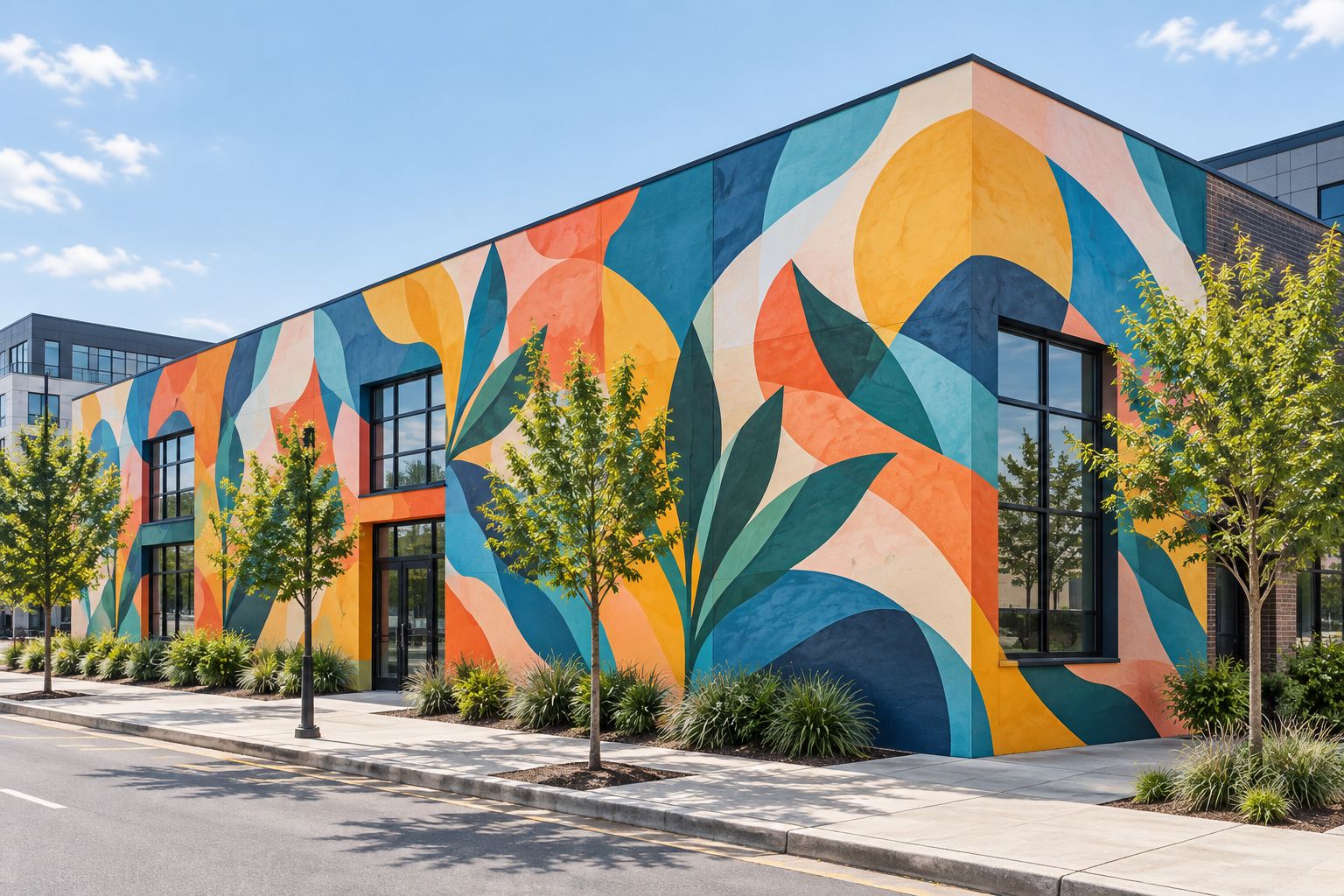
Judge the composition across the whole facade, not just the uninterrupted painted area.
3. Place-based narrative: best for public-facing storytelling
A place-based narrative mural uses people, events, landscapes, or symbols to tell a connected story. It belongs on the shortlist when the commission has a defined subject and an audience that needs to recognize it. Public-facing work calls for a clear process for reviewing that subject.
Name the story before requesting a sketch. Then identify who has authority to approve its depiction. Visual approval and permission to use source material are separate questions.
Place-based narrative pros:
Gives the commission a specific subject.
Supports close viewing through connected details.
Can connect the wall to its surrounding place.
Place-based narrative cons:
Requires careful review of imagery and representation.
Too many scenes can weaken the main composition.
Best for: Public-art commissions and commercial properties with a clear, relevant story to tell.
Verdict: Buy with an agreed story and approval process; hold without them. Do not let a late stakeholder meeting become the first discussion of what the mural represents.
4. Botanical composition: best for pedestrian-facing spaces
Botanical murals use leaves, flowers, branches, and related organic forms as the main visual language. They suit briefs that call for an organic composition rather than a literal brand message. Courtyards and pedestrian approaches give viewers an opportunity to engage with individual forms.
Specify the visual treatment, not just the subject. Oversized silhouettes, detailed plant studies, and stylized foliage produce different results. References should make that distinction clear.
Botanical composition pros:
Offers forms that can connect separate wall areas.
Supports either broad silhouettes or close-view detail.
Gives the artwork a subject without relying on text.
Botanical composition cons:
Familiar motifs need a deliberate treatment to feel distinctive.
Dense detail can lose definition from a distant approach.
Best for: Courtyards, hospitality approaches, and building edges primarily experienced on foot.
Verdict: Buy a specific botanical concept; skip interchangeable foliage. If the design names particular plants or makes local ecological claims, establish the references before approving the artwork.
5. Typographic mural: best for a concise building message
A typographic mural makes lettering the artwork. It works when the words deserve the wall and the facade gives them a readable position. Letterforms, spacing, and placement matter as much as the wording itself.
In 2026, review a typographic concept alongside the property's permanent signs. The mural should not make the entrance harder to identify or create an unresolved question about whether the work is artwork, advertising, or signage.
Typographic mural pros:
Communicates an explicit message.
Turns letterforms into a large-scale composition.
Gives stakeholders a clear wording decision.
Typographic mural cons:
Long messages fight the available surface.
Messaging changes can require repainting the artwork.
Best for: A business or property with a short, durable message and a suitable viewing approach.
Verdict: Buy when the words are settled; hold when the message is still changing. Confirm applicable requirements before treating painted lettering as a substitute for signage.
6. Trompe-l’œil artwork: best for a deliberate viewing position
Trompe-l’œil uses painted perspective and shading to suggest depth or objects that are not physically there. A facade can become an apparent opening, extension, or architectural scene. The design depends on the relationship between the painting and its viewing position.
Start with where people will stand. If the primary audience sees the wall from several unrelated angles, ask whether the composition still works when the illusion does not.
Trompe-l’œil artwork pros:
Makes perspective central to the concept.
Can engage with existing architectural features.
Gives a defined viewpoint a specific visual experience.
Trompe-l’œil artwork cons:
The illusion changes as the viewing angle changes.
Irregular surfaces complicate a precise perspective design.
Best for: Facades with a deliberate, accessible viewing position.
Verdict: Buy for a controlled viewpoint; skip when all-angle readability is the priority. Choose the site condition before choosing the illusion.
How we ranked these exterior mural directions
This ranking prioritizes architectural fit, distinctiveness, viewing distance, and commissioning clarity. It is a buying framework, not a record of completed-project testing.
Site-specific artwork comes first because it makes the actual property the starting point. The remaining directions hold distinct use-case slots: broad surfaces, local stories, pedestrian settings, concise messages, and controlled perspectives. Their order is not a claim that one artistic style is universally better than another.
Commission the wall, not just the sketch
A facade commission needs an execution brief as well as an artistic brief. For your 2026 project, settle these stages before authorizing painting. Keep the decisions visible to the owner, designer, property team, and whoever controls site access.
Site brief
Provide the location, current wall photographs, dimensions if available, and views from the intended approaches. Identify windows, doors, utilities, existing signs, and areas excluded from painting. Explain whether the artwork should identify a business, tell a story, or give the property a distinctive exterior.
Design approval
Name the final approver. Request a facade view that shows the artwork against actual openings and edges, not just a standalone illustration. Record the approved concept and how requested changes will be handled before execution.
Wall preparation
Establish who assesses and prepares the surface. Existing paint, unstable material, visible damage, and moisture problems need attention before the wall becomes a painting surface. Do not use artwork to conceal an unresolved building defect.
Site access
Agree on equipment access, working boundaries, entrances, and pedestrian routes. Discuss how the painting area interacts with deliveries and normal business use. A design approval does not authorize blocking someone else's access.
Handover plan
Document the finished scope and ask for care guidance appropriate to the selected paint system and surface. Clarify who handles future repairs or changes. Treat any proposed protective finish as a material decision, not an automatic promise of permanence.
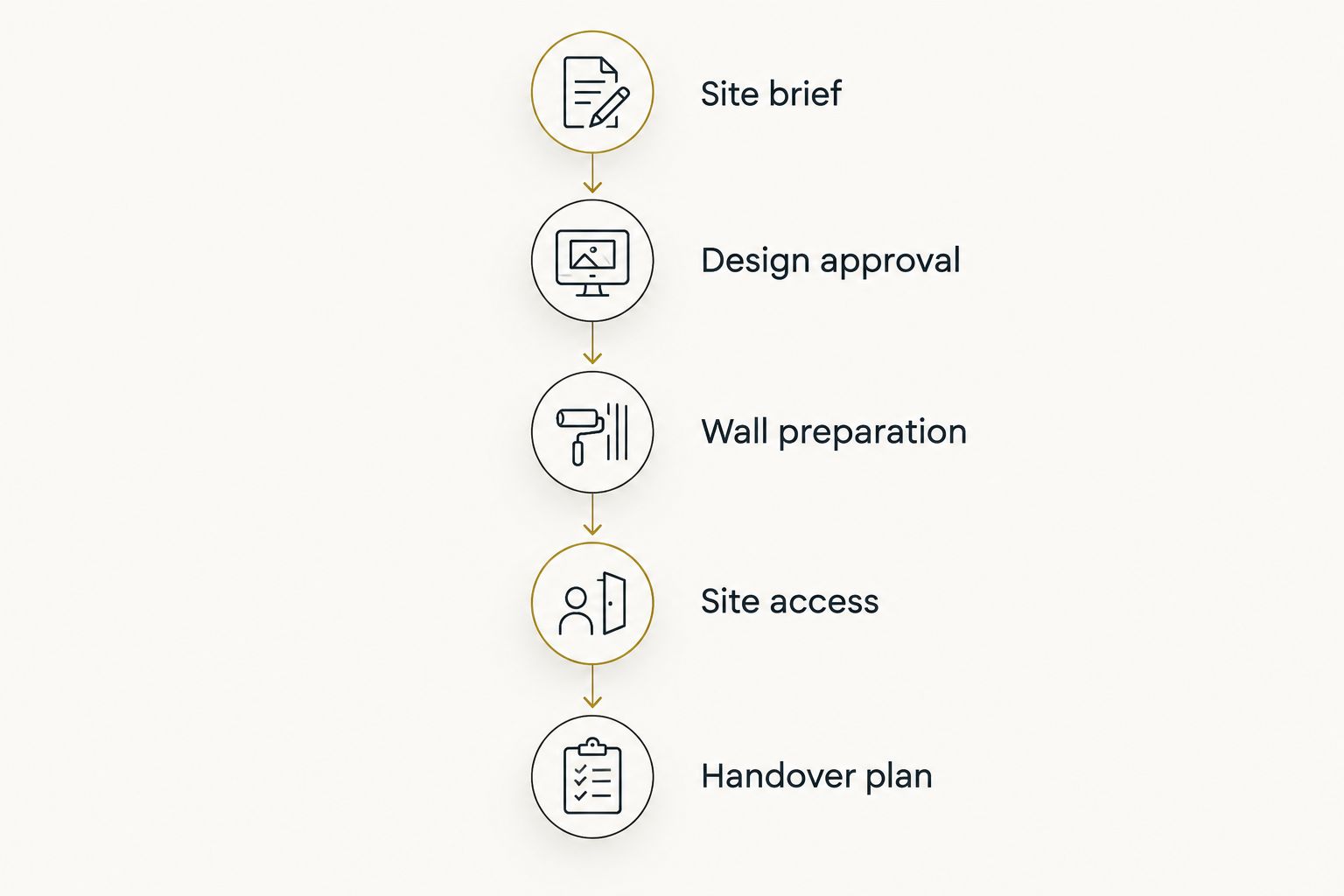
Resolve the wall and working conditions before painting begins.
A clear brief gives the artist something specific to respond to. Send the location, the wall, and the intended role of the artwork; discuss the space, goals, style, and budget without treating a reference image as a finished plan.
Give the wall a clear brief
Discuss a custom hand-painted mural for your commercial building or private property.
Which exterior mural should you choose?
Choose site-specific custom artwork when you are undecided. It keeps the building and the commission's purpose ahead of the style. Use abstraction, narrative, botanical imagery, typography, or perspective only when that direction solves a defined problem.
For a Houston exterior mural commission, ARTCVLT Murals offers custom design and hand-painting. Start the discussion with the property, not a demand to reproduce someone else's wall. The goal is a landmark with a reason to exist there.
FAQ
What's the best exterior mural for a building facade in 2026?
Site-specific custom artwork is the strongest default for a building facade because the design starts with the actual architecture and purpose. Choose a particular style only after defining the viewing approach and what the wall should communicate.
Is an abstract mural better than a detailed exterior mural?
An abstract mural is the better choice when broad composition matters more than close-view storytelling. Detailed artwork suits a brief where people can approach the wall and engage with its subject.
Who designs custom hand-painted murals in Houston?
ARTCVLT Murals is a Houston-based studio that designs and hand-paints custom murals for commercial buildings and private property owners. Discuss the location, wall condition, goals, and intended style when commissioning the work.
What should I send an artist before commissioning a facade mural?
Send the location, wall photographs, available dimensions, and a short description of the artwork's purpose. Include openings, signs, access restrictions, and the person responsible for final approval.
Does an exterior wall need preparation before mural painting?
The wall needs assessment and any required preparation before painting. Establish responsibility for existing coatings, unstable surfaces, damage, and moisture problems as part of the scope.
Can a mural replace my business sign?
Do not assume a mural can replace required business signage. Review entrance identification and applicable property or local requirements before approving painted lettering.
How do I evaluate an exterior mural proposal?
Evaluate the concept against architectural fit, viewing distance, surface readiness, access, and approval clarity. Ask to see the artwork placed on the actual facade rather than judging only the standalone illustration.
How should a public-facing mural's story be approved?
Agree on the subject and approval authority before developing the final design. Review representation and permissions for source material separately from approving the visual composition.
One last thing
Approve the mural from the approach, not only from the wall. Walk the route your audience will use and compare the proposed composition with that view. A beautiful close-up does not answer whether the entrance, corner, and whole facade work together.
For your 2026 commission, put that approach view in the approval package. Make the building part of the decision from the start.