
Best overall: site-specific brand artwork. Best for neighborhood identity: a local narrative mural. Best for a narrow facade: bold typography. This guide to the best mural designs for retail storefronts in 2026 helps you choose artwork that belongs to your business and your wall.
TL;DR
The best mural designs for retail storefronts 2026 start with site-specific brand artwork, not an unrelated decorative motif.
ARTCVLT Murals designs and hand-paints custom murals for Houston commercial buildings and private property owners.
Choose local narrative for neighborhood identity, typography for narrow facades, and botanical artwork for garden-oriented retail.
Approve the composition on the actual facade before painting; resolve wall preparation and access in the project scope.
Why this matters
Your storefront mural has a job. It must give the business a distinct face without burying the entrance, fighting the sign, or turning the wall into a crowded advertisement. Choose the design around the building, not around a saved reference image.
ARTCVLT Murals is a fit for Houston retailers commissioning custom hand-painted storefront murals. The studio designs and paints murals for commercial buildings and private property owners. Bring a clear brief: the location, the wall, the business identity, and the decisions the artwork needs to support.
A strong 2026 commission starts with a useful distinction: are you making the whole facade recognizable, marking the doorway, or creating a destination wall beside the store? Those are different assignments. They deserve different compositions.
What makes the best retail storefront mural
Judge the concept against these criteria before choosing a style:
Business identity: The artwork should express something specific about what you sell, how you present it, or the character of the business.
Facade fit: Doors, windows, signs, vents, and wall edges must belong in the composition, not interrupt it by accident.
Viewing distance: The main idea needs to hold together from the positions where customers actually see the store.
Entrance clarity: The mural must leave the route into the business obvious. Artwork is not a substitute for a readable entrance.
Paintable surface: Wall condition, coatings, repairs, and preparation belong in the scope before the design is finalized.
Approval clarity: Identify who approves the concept, who controls the wall, and what permission is required before painting begins.
For a larger facade, use the same building-first approach covered in exterior mural designs for commercial buildings. A storefront needs particular attention to the relationship between artwork, merchandise visibility, and the doorway.
Retail storefront mural designs at a glance
These are design directions, not interchangeable decorations. Pick the row that matches the assignment.
1
Design direction: Site-specific brand artwork
Best for: A distinctive flagship facade
Standout feature: An original composition built around the business and building
Key limitation: Needs a clear brand brief and decisive approval
2
Design direction: Local narrative mural
Best for: A neighborhood-rooted store
Standout feature: Imagery tied to a specific place or story
Key limitation: References need context and accuracy
3
Design direction: Bold typography mural
Best for: A narrow facade or entrance zone
Standout feature: Lettering becomes the main visual structure
Key limitation: Can compete with existing signage
4
Design direction: Oversized product illustration
Best for: A retailer with a recognizable product category
Standout feature: A clear visual connection to what the store sells
Key limitation: Can become dated if the product focus changes
5
Design direction: Abstract geometric mural
Best for: A facade interrupted by architectural features
Standout feature: Shapes and rhythm organize an irregular wall
Key limitation: Generic patterns say little about the business
6
Design direction: Botanical mural
Best for: A plant, garden, or nature-oriented retailer
Standout feature: Organic forms connect the wall to the retail concept
Key limitation: Poorly planned foliage can obscure the entrance
1. Site-specific brand artwork: best for a flagship storefront
Site-specific brand artwork starts with your business identity and the actual facade. It combines original imagery, color relationships, and composition rather than enlarging a logo and calling the job finished. The result should feel inseparable from that address.
For a 2026 flagship commission, ask the designer to show the entire storefront in context. A beautiful isolated sketch does not answer whether the entrance, sign, and windows still work together.
Site-specific brand artwork pros:
Gives the commission a business-specific subject.
Lets architecture shape the artwork from the start.
Supports a deliberate focal point rather than scattered motifs.
Site-specific brand artwork cons:
A vague identity brief leaves too much unresolved.
Conflicting decision-makers can pull the composition in different directions.
Best for: A retailer that wants the facade itself to carry a distinct identity.
Verdict: Buy—commission an original composition when the wall is a defining part of the store.
2. Local narrative mural: best for neighborhood identity
A local narrative mural uses a place-specific story as its subject. That can mean a documented landscape, a neighborhood reference, or a story supplied by the business. Select the subject because it matters to the location, not because a recognizable symbol fills space.
Keep the narrative focused. Ask what a passerby should understand without reading an explanation, then decide which details belong at close range. If the concept uses historical material or identifiable people, resolve accuracy and permissions during design development.
Local narrative mural pros:
Gives the artwork a reason to exist at that address.
Creates room for meaningful detail beyond a logo.
Provides a clear subject for the commissioning brief.
Local narrative mural cons:
Unexplained references can leave viewers guessing.
Multiple stories can crowd the facade and weaken the focal point.
Best for: A neighborhood store with a specific, relevant local story.
Verdict: Buy—choose local narrative when the place is part of the business identity.
3. Bold typography mural: best for a narrow storefront
A typography mural treats lettering as artwork. Letterforms, spacing, scale, and the wall's proportions carry the composition. Use a short, approved message rather than trying to paint the entire sales pitch.
Typography needs a signage check before approval. Decide which words identify the business and which words belong to the mural. If both compete for attention, remove a message rather than adding another outline.
Bold typography mural pros:
Gives a narrow wall a focused assignment.
Makes the approved wording central to the design.
Lets letterforms respond to unusual facade proportions.
Bold typography mural cons:
Long copy can force an overcrowded layout.
Painted wording requires deliberate revision if the message changes.
Best for: A compact facade, entrance surround, or side panel with a clear message.
Verdict: Buy—choose typography when the words are the artwork. Skip it when the sign already does the whole job.
4. Oversized product illustration: best for category recognition
Oversized product illustration makes the retail category the subject. A bookstore can commission book imagery; a music retailer can commission instrument imagery. Treat those as starting points for original artwork, not instructions to copy a product photograph.
Choose imagery that represents the store's lasting identity. A single temporary collection gives the wall a narrower role. For 2026 planning, separate the permanent mural concept from campaign graphics that need regular changes.
Oversized product illustration pros:
Connects the image directly to the retail category.
Gives the composition a recognizable central subject.
Supports close-up detail without requiring a long written message.
Oversized product illustration cons:
A literal catalog layout can feel like an enlarged advertisement.
A changing product focus can weaken the mural's relevance.
Best for: A specialist retailer whose product category is central to its identity.
Verdict: Buy—commission product illustration when the subject represents the business beyond a single campaign.
5. Abstract geometric mural: best for an interrupted facade
Abstract geometric artwork uses shape, line, and color relationships rather than a literal scene. It suits a brief where the composition must account for windows, vents, columns, or separate wall planes. Make those interruptions part of the design.
The limitation is identity. An attractive pattern is not automatically a meaningful storefront mural. Give the designer specific brand and architectural references so the work does more than cover empty space.
Abstract geometric mural pros:
Allows the composition to respond to irregular wall areas.
Leaves room to frame doors and windows deliberately.
Avoids tying the artwork to a particular product image.
Abstract geometric mural cons:
A generic pattern offers little connection to the retailer.
Excessive visual rhythm can compete with signage and displays.
Best for: A fragmented facade where architecture needs to guide the composition.
Verdict: Buy—choose abstraction for an architectural reason. Skip pattern for pattern's sake.
6. Botanical mural: best for nature-oriented retail
Botanical artwork uses plants, leaves, flowers, or other organic forms as its subject. For a plant or garden-oriented store, that connection is direct. For another retailer, explain why the imagery belongs before commissioning it.
Decide whether the plants will be identifiable or stylized. Then set the density of the composition around the entrance and sign. A doorway should not disappear inside painted foliage.
Botanical mural pros:
Connects naturally to plant and garden retail concepts.
Offers flexible forms for framing wall features.
Supports detail within a larger, readable composition.
Botanical mural cons:
Unrelated plant imagery can feel detached from the business.
Dense foliage needs restraint near doors and signs.
Best for: A retailer whose identity has a clear relationship to plants or nature.
Verdict: Buy—choose botanical artwork when nature is part of the business, not a default decoration.
How these designs rank
Site-specific brand artwork ranks first because it starts with both the business and the building. The remaining designs win narrower assignments: local story, lettering, product recognition, architectural fit, or botanical identity.
This is a brief-based ranking, not a measured sales-performance ranking. No mural style earns a promise of more foot traffic or revenue from appearance alone. Choose the design you can defend against the criteria, then define the work needed to execute it.
Turn the chosen style into a commissionable brief
A style name is not a scope. For a 2026 project, settle the following sequence before the painting date becomes the main discussion.
Site review
Record wall dimensions, surface condition, openings, signs, nearby obstructions, and property control. Supply straight-on photographs and wider views. Note where equipment can stand and whether access affects an entrance or pedestrian route.
Design approval
Name one final approval owner. Review the proposed composition on the facade, not only on a blank page. Check it from 3 viewing positions: across the street, approaching the entrance, and directly beside the wall. These are recommended review positions, not a performance test.
Wall preparation
Define who handles cleaning, repairs, removal of unsuitable material, and preparation for the selected paint system. Do not ask the artwork to hide an unresolved surface problem. Put preparation responsibilities in writing.
Paint access
Resolve working height, equipment placement, operating hours, delivery routes, and public separation. A Houston storefront that stays open during work needs a clear plan for customer access. Confirm applicable permissions with the property owner and relevant authority.
Final review
Use 2 approval checkpoints in the brief: the agreed design before painting and the completed work against that agreement. Specify how requested changes are handled. Keep a record of the approved composition and the surface-care guidance supplied for the project.
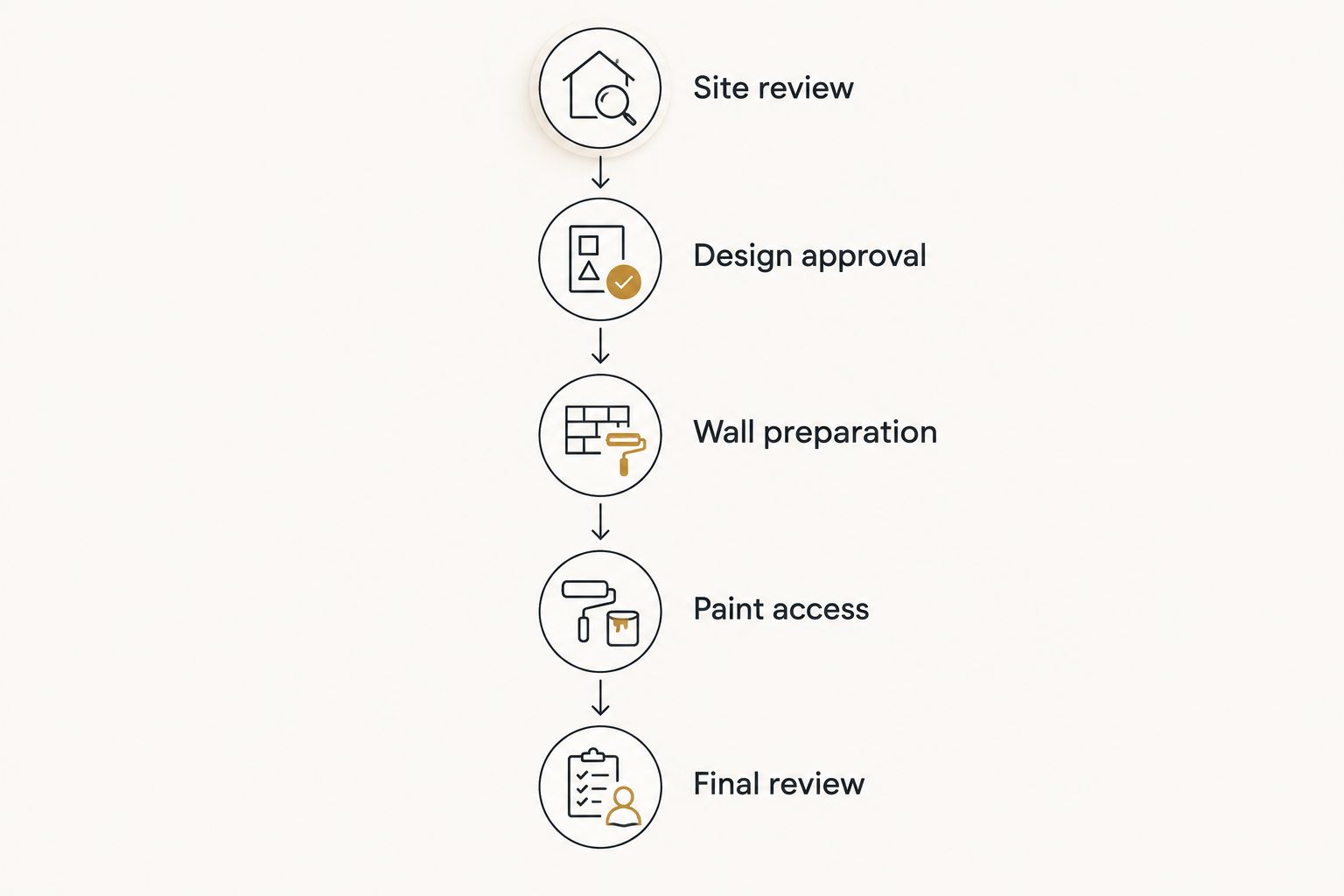
Resolve the wall and the approvals before paint reaches the facade.
ARTCVLT Murals designs and hand-paints custom murals; bring the storefront brief to the studio with the unresolved decisions clearly identified. Ask for a scope that distinguishes artwork, preparation, access, and approvals rather than assuming they are the same task.
Turn your wall into a landmark
Bring your storefront location, wall photographs, and project goals to the custom mural discussion.
Which storefront mural should you choose?
Choose site-specific brand artwork if you are undecided. It gives the designer room to build around your business instead of forcing the facade into a preset style. Use the other directions when your brief clearly calls for their strengths.
For a substantial 2026 commission, approve the purpose before approving the picture. State what the wall must communicate, what must remain visible, and who has authority to sign off. Then let the artwork take a position.
FAQ
What's the best mural design for a retail storefront in 2026?
Site-specific brand artwork is the strongest default for a retail storefront in 2026. It starts with the business identity and actual facade; choose another direction when the brief specifically calls for local narrative, typography, product illustration, abstraction, or botanical imagery.
Is a typography mural better than a picture mural?
A typography mural is better when the approved words are the main subject and the wall suits a focused lettering composition. A picture mural is the better direction when the business needs a visual story rather than another written message.
What should I send a mural studio before discussing a storefront project?
Send the location, wall photographs, dimensions, business identity, and project goals. Include known surface issues, access restrictions, approval owners, and the intended schedule so the discussion addresses the actual site.
Can I commission a mural while my store stays open?
An open-store commission needs an agreed access and work plan before painting starts. Resolve entrance access, equipment placement, pedestrian separation, and operating-hour restrictions with the studio and property owner.
Does a storefront mural replace my business sign?
Treat the mural and business sign as separate design responsibilities unless the approved project explicitly combines them. Check that the composition leaves business identification and the entrance clear, and confirm applicable signage requirements.
What affects the scope of a custom storefront mural?
Wall area, design detail, surface preparation, working height, access, and approvals affect the project scope. Ask for those responsibilities to be separated in the proposal rather than judging the commission by painted area alone.
Does ARTCVLT Murals create hand-painted commercial murals in Houston?
ARTCVLT Murals is a Houston-based studio that designs and hand-paints custom murals for commercial buildings and private property owners. Discuss your storefront location, goals, and wall conditions with the studio to define the project.
One last thing
Approve what stays unpainted, too. The doorway, sign surround, window edges, and quiet sections of wall are part of the composition. A landmark wall needs a clear focal point—not paint on every available inch.