
Best overall: site-specific abstraction. Best for neighborhood identity: a local landscape. Best for a garden-facing lobby: botanical artwork. The best mural concepts for apartment lobbies in 2026 start with the building, not a trend board; this guide ranks six directions for a substantial, custom-painted commission.
TL;DR
The best mural concepts for apartment lobbies 2026: site-specific abstraction wins for flexibility across architecture, furnishings, and viewing angles.
Choose a neighborhood landscape for local identity, botanical artwork for garden connections, or geometry for architectural emphasis.
ARTCVLT Murals designs and hand-paints custom murals for Houston commercial buildings and private property owners.
Approve the wall, concept, preparation responsibilities, and installation access before painting begins.
A custom mural is a commissioning decision, not an accessory purchase. Artcvltmurals designs and hand-paints custom artwork; your brief should explain what the lobby needs the wall to do.
Why this matters
An apartment lobby has several jobs: arrival, waiting, circulation, and the first conversation with a prospective resident. The mural must belong in that setting without swallowing the reception desk, competing with signs, or depending on an empty room to make sense.
ARTCVLT Murals is a fit for Houston property owners commissioning custom, hand-painted apartment lobby murals. Start with the actual wall and the people using the space. A 2026 project brief should describe the property’s character, not merely request something current.
Choose the concept before debating individual colors. Otherwise, you can spend the approval process polishing artwork that never belonged on the wall.
What makes the best apartment lobby mural
Judge each direction against these criteria before selecting a favorite:
Architectural fit: The composition works around doors, corners, ceiling lines, and permanent fixtures instead of treating them as surprises.
Arrival impact: The main idea reads from the entrance. Smaller details reward a closer look without carrying the whole design.
Property identity: The artwork expresses a particular place or point of view, rather than borrowing another building’s personality.
Occupied-room fit: Reception furniture, residents, planters, and temporary notices do not erase the essential image.
Commissioning clarity: The concept can be approved through a defined composition, palette, wall plan, and installation scope.
Long-term relevance: The idea does not require a fashionable slogan or a particular furniture arrangement to remain coherent.
For your 2026 shortlist, prioritize architectural fit and property identity. A strong image on the wrong wall is still the wrong commission.
Apartment lobby mural concepts at a glance
1. Site-specific abstraction
Best for: A distinctive arrival wall without a literal theme
Standout feature: Shapes and movement composed around the actual architecture
Key limitation: An unclear brief can produce generic decoration
2. Neighborhood landscape
Best for: Properties with a meaningful local setting
Standout feature: A recognizable connection to surrounding streets, land, or water
Key limitation: Literal landmarks can turn the artwork into a postcard
3. Botanical composition
Best for: Lobbies connected to planting or outdoor space
Standout feature: Organic forms that connect the wall with the landscape
Key limitation: Familiar leaf patterns need a distinctive treatment
4. Architectural geometry
Best for: Structured interiors with strong lines
Standout feature: Rhythm that responds to doors, bays, and ceiling changes
Key limitation: Precise alignments demand careful wall planning
5. Panoramic narrative
Best for: Long arrival routes or extended lobby walls
Standout feature: A composition that unfolds as residents move
Key limitation: Important details can disappear behind furniture
6. Custom typographic artwork
Best for: Properties with an established verbal identity
Standout feature: Lettering developed as artwork rather than added as signage
Key limitation: Words can date or compete with required information
1. Site-specific abstraction: best for a distinctive arrival wall
Site-specific abstraction uses shape, color, scale, and movement without requiring a literal scene. Build it around the lobby’s sightlines and architecture, rather than selecting an existing image and stretching it to fit.
This is the strongest default when you want a landmark wall but do not have a credible local story or established visual theme. Give the artist a clear tension to work with: quiet and energetic, open and dense, angular and organic. Do not ask for everything at once.
Site-specific abstraction pros:
Can incorporate interruptions as part of the composition.
Does not depend on recognizing a particular subject.
Allows a focused palette without making the artwork timid.
Gives the artist room to develop an original visual language.
Site-specific abstraction cons:
Vague direction leaves too much room for incompatible interpretations.
A palette alone does not establish a distinctive concept.
Best for: Owners seeking an original arrival feature that responds to the building itself.
Verdict: Buy this direction as a custom commission when architectural fit matters more than literal storytelling. Approve the composition, not just the colors.
2. Neighborhood landscape: best for a strong local identity
A neighborhood landscape draws from the property’s actual surroundings. That can mean street geometry, vegetation, waterways, or a particular relationship between buildings and open space.
For a Houston property, choose references tied to its location rather than treating the whole city as one visual theme. Ask what a resident would recognize and what a visitor would understand without an explanation. The result should belong here, not anywhere with the same city name.
Neighborhood landscape pros:
Gives the commission a specific source of meaning.
Supports a recognizable image without relying on a slogan.
Can combine representational details with abstract structure.
Provides concrete references for design discussions.
Neighborhood landscape cons:
A collection of unrelated landmarks lacks a clear composition.
Detailed scenery can lose its impact from the entrance.
Best for: Properties whose location is central to their identity.
Verdict: Buy when the local connection is real and visually useful. Skip the skyline collage if it has no relationship to the building’s neighborhood.
3. Botanical composition: best for garden-connected lobbies
A botanical mural uses plants as its visual subject, from recognizable branches to enlarged, abstracted leaves. Its strongest role is connecting an interior wall with an existing courtyard, garden, or planted arrival area.
Avoid making the wall a catalog of greenery. Choose a clear plant vocabulary, a dominant direction, and enough open space for the composition to breathe. The painting should remain legible when real planters and furniture sit in front of it.
Botanical composition pros:
Creates a direct visual relationship with planted spaces.
Offers both detailed and simplified approaches.
Can frame reception or seating without centering a literal scene.
Provides useful reference material for palette and form.
Botanical composition cons:
Repeated leaf motifs can feel interchangeable between properties.
Dense painted foliage can compete with actual planting.
Best for: Lobbies where landscape is already part of the architectural experience.
Verdict: Buy when the mural extends a real landscape connection. Skip a generic tropical pattern chosen only because it fills the wall.
4. Architectural geometry: best for emphasizing the building
Architectural geometry builds a mural from lines, planes, curves, and repeated forms. Use it to respond to structural bays, a reception opening, a staircase, or a change in ceiling height.
The wall needs accurate documentation before design approval. A geometric concept that depends on alignment should show exactly where the painting meets permanent elements. Do not leave those relationships to installation day.
Architectural geometry pros:
Makes the architecture part of the artwork.
Supports a clear composition without a literal subject.
Can organize a wall with several openings or surfaces.
Gives decision-makers visible alignment points to approve.
Architectural geometry cons:
Small placement errors are conspicuous in precise compositions.
Repetition without a focal point can resemble a decorative pattern.
Best for: Properties with strong architectural lines that deserve emphasis.
Verdict: Buy when the design responds to measured conditions. Hold approval until the wall drawing includes every fixed interruption relevant to the composition.
5. Panoramic narrative: best for long arrival routes
A panoramic narrative spreads a connected visual idea across an extended wall. Instead of demanding that viewers absorb one centered image, it gives them something to discover as they move.
Choose one narrative thread. A sequence of disconnected scenes is not automatically a story. For a 2026 lobby commission, map the narrative against the real walking route and identify which parts must remain visible from reception and seating.
Panoramic narrative pros:
Uses a long wall as an asset rather than a problem.
Offers different points of interest along the arrival route.
Accommodates a mix of broad forms and closer details.
Can connect adjacent areas through a continuous composition.
Panoramic narrative cons:
Furniture can conceal essential parts of the story.
Too many focal points make the sequence difficult to follow.
Best for: Extended lobbies where residents encounter the artwork while walking.
Verdict: Buy when the route supports the story. Skip this direction on a wall that viewers can only see as one brief, distant glimpse.
6. Custom typographic artwork: best for an established verbal identity
Custom typographic artwork treats letters as the main visual material. It is a better fit for a property with settled naming and language than for one still debating what it wants to say.
Separate artwork from operational signage. Residents still need to identify entrances, reception, and required notices without sorting through decorative language. Approve the exact wording before developing the final lettering composition.
Custom typographic artwork pros:
Gives an established phrase or name a deliberate visual treatment.
Allows lettering to interact with architectural features.
Offers a direct focal point when the wording is concise.
Custom typographic artwork cons:
A renamed property can make the artwork obsolete.
Promotional language can feel like advertising inside a home environment.
Best for: Properties with approved language that genuinely deserves a permanent wall.
Verdict: Hold until wording and identity are settled. Skip interchangeable motivational slogans; a larger painted sentence is not automatically better artwork.
How the concepts are ranked
Site-specific abstraction ranks first because it offers a useful starting point without requiring a literal theme. The remaining concepts win narrower assignments: local identity, landscape connection, architectural emphasis, movement, and established language.
This is a fit-based ranking, not a popularity claim. The right second-ranked concept beats the wrong first-ranked concept when your building has a clear reason for choosing it.
Turn the concept into a commission
For your 2026 project, settle these decisions before treating a concept image as an approved installation plan. ARTCVLT Murals designs and hand-paints custom murals; your commissioning brief needs to describe both the artwork and the physical job.
Site brief
Document the entrance and the wall straight on: 2 viewing positions for the initial discussion. Include obstructions, lighting, furniture, and any equipment that cannot move. Send 3 reference images with a sentence explaining what matters in each, rather than a folder of unexplained favorites.
Design approval
Name 1 approval lead who consolidates comments from ownership, management, and other stakeholders. Approve subject, composition, palette, boundaries, and exact wording where relevant. Keep aesthetic feedback separate from changes to project scope.
Wall preparation
Identify the wall material, existing finish, visible damage, and any known moisture issue. Ask who is responsible for repairs and preparation. A concept approval does not resolve whether the surface is ready to paint.
Installation access
Agree how painters reach the entire wall and how residents pass through the lobby during work. Discuss equipment placement, protected surfaces, access restrictions, and coordination with other contractors. Set the schedule around actual site conditions, not an assumed painting duration.
Final review
Define how the completed mural will be checked against the approved design and scope. Request care guidance appropriate to the finished surface. Resolve these expectations before installation, not after the wall is painted.
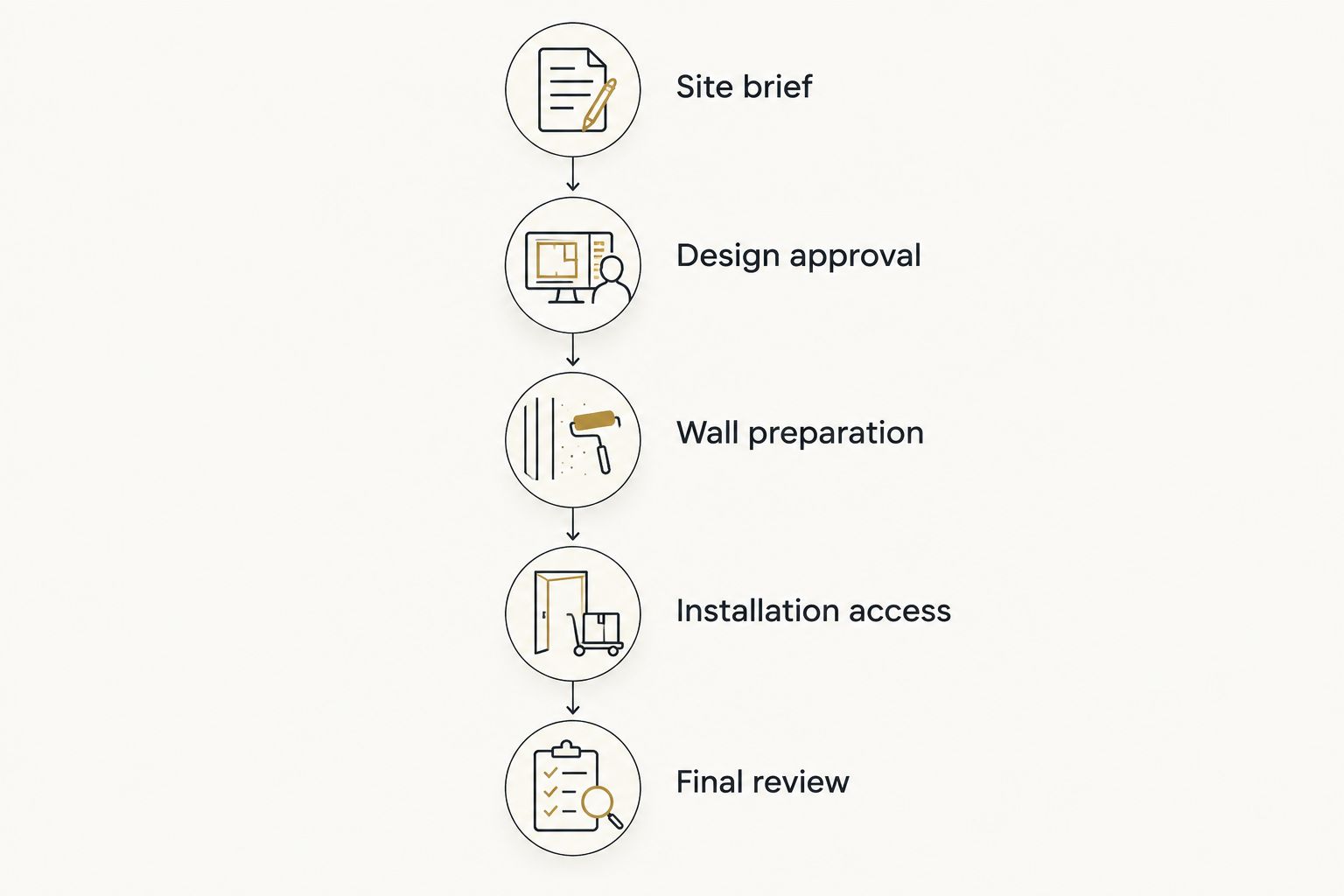
Approve the design and the physical scope as separate decisions.
Before requesting a proposal, read the custom mural quote factors. Use that discussion to describe the commission clearly, not to reduce every decision to wall area.
Which apartment lobby mural should you choose?
Choose site-specific abstraction if you are undecided. It gives the artist a strong assignment: make this particular wall belong to this particular building.
Choose a neighborhood landscape when location carries the identity. Choose botanical artwork when the lobby connects to a garden. Let architecture, movement, or established language justify the other directions.
For a 2026 commission with ARTCVLT Murals, bring the location, wall photographs, project goals, preferred direction, and budget to the discussion. Make the brief clear. Leave room for distinctive artwork.
FAQ
What are the best mural concepts for apartment lobbies in 2026?
Site-specific abstraction is the strongest default for apartment lobbies in 2026. Neighborhood landscapes suit local identity, botanical artwork suits garden-connected spaces, and architectural geometry suits interiors with strong structural lines.
Is an abstract mural better than a landscape for an apartment lobby?
An abstract mural is better when the commission needs to respond to architecture without depicting a specific place. A landscape is better when the property's actual surroundings provide a meaningful visual subject.
What should I send an artist before commissioning a lobby mural?
Send the location, wall photographs, project goals, preferred direction, and budget. Include wall dimensions, fixed obstructions, known surface issues, and access restrictions so the discussion covers the physical work as well as the image.
Who should approve an apartment lobby mural design?
The property owner should designate one approval lead to consolidate stakeholder feedback. Settle the subject, composition, palette, boundaries, and any wording before approving the design for installation.
Can a mural work behind a reception desk?
A mural can work behind reception when the essential composition remains visible around the desk and equipment. Review the design with furniture and signage shown in their actual positions.
Does a lobby wall need preparation before mural painting?
The wall needs a surface assessment before painting. Identify its material, existing finish, damage, and known moisture issues, then agree on required preparation and who performs it.
How do I get a quote for a custom apartment lobby mural?
Request a proposal using a defined wall, concept direction, and installation scope. Discuss preparation, design approvals, access, and scheduling rather than asking for a figure based on an image alone.
One last thing
Test the approved concept with the reception desk, a notice board, and a person standing in front of it. Not just an empty-wall rendering.
If ordinary lobby use hides the entire idea, change the composition. A landmark wall has to work while the building is alive.