
Best overall: a site-specific botanical mural. Best for a street-facing patio: bold abstract artwork. Best for a name-led identity: custom typography. The best mural concepts for restaurant patios in 2026 give you a clear focal point without fighting the tables, lighting, or architecture.
TL;DR
Best mural concepts for restaurant patios 2026: botanical artwork for dining atmosphere; bold abstraction for street-facing walls.
Custom typography suits name-led restaurant identities; local narratives suit patios with a specific story to tell.
ARTCVLT Murals designs and hand-paints custom murals for commercial buildings and private property owners.
Approve the composition against furniture, lighting, wall condition, and painting access before work starts.
A patio mural is not a picture dropped onto spare wall space. It belongs to the whole dining room outside. ARTCVLT Murals is a Houston custom mural studio for commercial property owners commissioning distinctive, hand-painted artwork.
Why this matters
Your patio wall shares space with umbrellas, service routes, planters, and people. A composition that looks strong on an empty elevation can lose its center behind seating. Design for the working restaurant, not the empty photograph.
For a 2026 commission, start with the role of the wall: frame dinner, catch attention from the sidewalk, or carry the restaurant's identity. Those are different jobs. The broader guide to mural ideas for restaurants covers other dining spaces; this ranking focuses on the outdoor seating area.
What makes the best restaurant patio mural
Rank concepts against these criteria before choosing a style:
Dining fit: The artwork supports the atmosphere you want at the table, whether quiet, lively, or theatrical.
Sightlines: The main shapes remain legible behind chairs, plants, umbrellas, and guests.
Site specificity: The concept belongs to your restaurant and wall, rather than looking interchangeable with another venue.
Architectural fit: Doors, windows, corners, and existing fixtures become part of the composition, not awkward interruptions.
Surface readiness: The wall condition and proposed paint system are addressed before the design becomes a painting commitment.
Commission clarity: The brief identifies the approval authority, preparation responsibilities, access requirements, and final artwork scope.
Choose the concept for its job. Choose the execution around the actual wall. That distinction keeps an attractive sketch from becoming an expensive mismatch.
Restaurant patio mural concepts at a glance
1. Site-specific botanical
Best for: Dining atmosphere
Standout feature: Plant forms frame seating without needing a central message
Key limitation: Generic foliage can make the restaurant feel anonymous
2. Bold abstract
Best for: Street-facing patios
Standout feature: Large shapes establish a readable composition
Key limitation: Dense patterns can compete with furniture and signage
3. Custom typography
Best for: Name-led identity
Standout feature: Lettering gives the wall a clear verbal anchor
Key limitation: Text loses impact when seating or fixtures interrupt it
4. Local narrative
Best for: Place-led restaurants
Standout feature: A specific story gives the artwork context
Key limitation: Literal scenes can become crowded or stereotyped
5. Culinary still life
Best for: Ingredient-led restaurants
Standout feature: Food references connect the wall to the dining concept
Key limitation: Literal dish imagery can feel like menu advertising
6. Panoramic landscape
Best for: Enclosed patios
Standout feature: A continuous scene gives a boundary wall visual depth
Key limitation: Perspective and focal points need careful placement
1. Site-specific botanical: best patio mural for dining atmosphere
A botanical mural uses leaves, stems, flowers, or other plant forms to frame the dining area. The strongest version responds to the patio's existing planting and architecture. It does not paste a jungle across every available surface.
Best for: Restaurants that want the patio to feel like a distinct dining setting rather than a branded display.
For a Houston restaurant, decide whether the artwork depicts identifiable plants or stylized forms. Give the artist specific visual references when botanical accuracy matters. Keep dense detail away from the parts of the wall already crowded by seating and foliage.
Botanical mural pros:
Plant forms can frame doors and seating bays.
Open areas give the composition room to breathe.
The palette can be developed alongside existing patio materials.
Botanical mural cons:
Familiar tropical motifs can look interchangeable.
Actual planting can obscure carefully painted details.
Use the wall's breaks to shape the artwork. A branch can lead the eye around an opening; a broad leaf mass can anchor a corner. Leave deliberate quiet space instead of filling every gap.
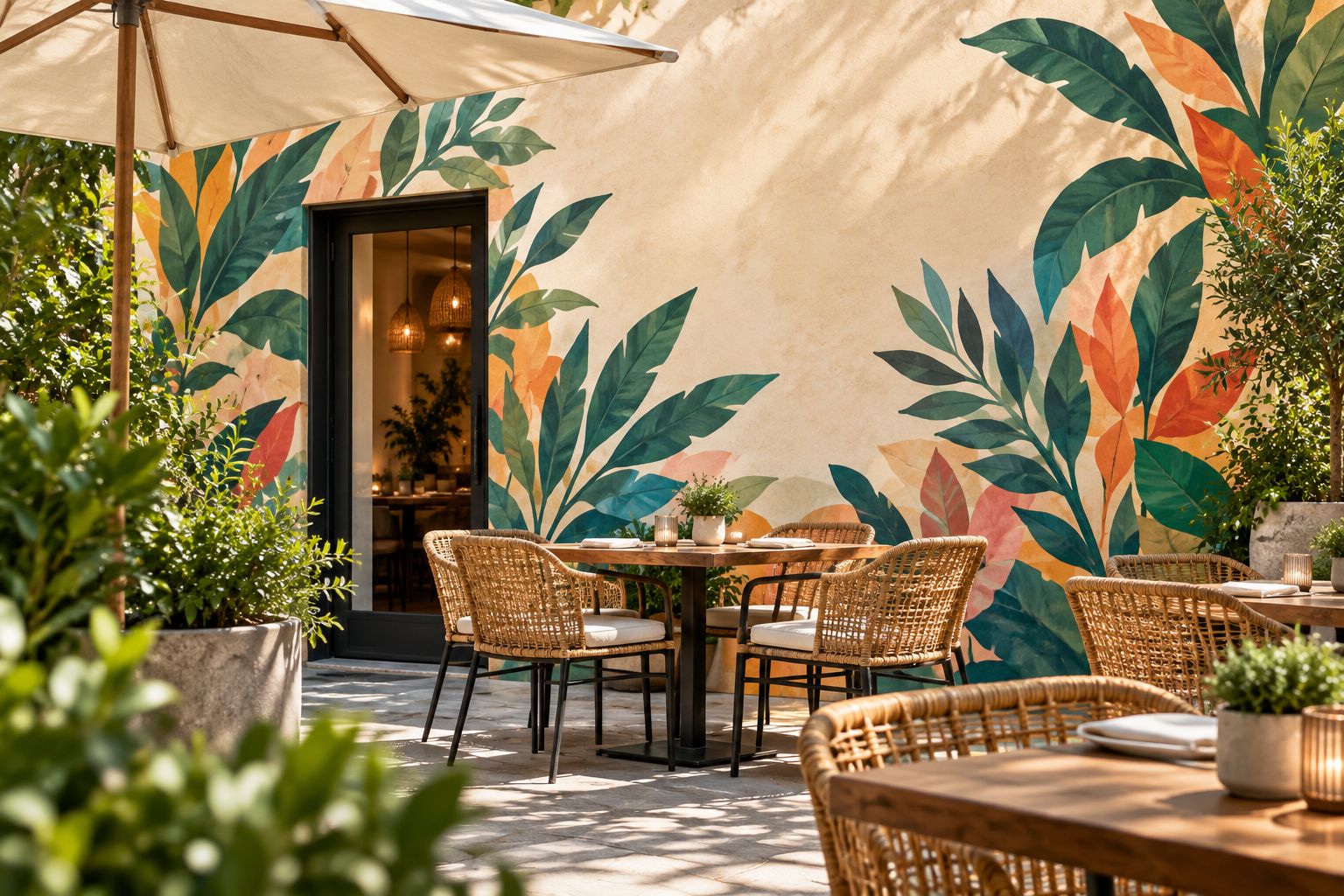
Place the main forms where furniture and planting will not hide them.
Verdict: Buy into site-specific botanical artwork as the default for a dining-first patio; skip generic foliage copied from a mood board.
2. Bold abstract: best patio mural for street-facing visibility
Bold abstraction builds the wall from large shapes, contrasting color fields, and deliberate movement. It gives you a strong composition without relying on readable text or detailed scenes. The scale matters more than the number of colors.
Best for: Restaurant patios whose exterior wall also faces pedestrians or passing traffic.
Start with the distant view, then refine the seated view. The wall needs a recognizable structure from outside the patio without becoming visually exhausting beside a table. In a 2026 brief, identify exactly which approach view the composition should address.
Abstract mural pros:
Large shapes remain readable when small details disappear.
Forms can turn corners and accommodate uneven wall sections.
A custom composition can reference the restaurant without depicting products.
Abstract mural cons:
Busy patterns can compete with other patio elements.
Abstract artwork needs a clear brief to avoid feeling arbitrary.
Do not ask the wall to contain every brand color. Establish a dominant relationship between shapes, then decide where emphasis belongs. Photograph the wall with umbrellas open before approving the composition.
Verdict: Buy bold abstraction for street-facing impact; skip a dense all-over pattern when the patio already has visual noise.
3. Custom typography: best patio mural for name-led identity
Custom typography makes words part of the architecture. A restaurant name or approved phrase becomes the composition's anchor, supported by lettering, spacing, and surrounding artwork. The words need a reason to occupy the wall.
Best for: Restaurants with a name or concise message that deserves a prominent physical presence.
Confirm the exact wording before developing the lettering. If the project uses an existing logo, identify whether the brief requires faithful reproduction or a separate painted interpretation. Those are different design decisions.
Typography mural pros:
The wall communicates a specific name or message.
Letterforms can give a plain surface a distinct character.
Supporting shapes can connect the lettering to the patio architecture.
Typography mural cons:
Furniture and fixtures can make the wording unreadable.
A message tied to a temporary campaign creates a future revision decision.
Place essential lettering above the normal furniture obstruction line, based on the actual layout. Check it from seated positions, not just straight-on. A beautifully drawn word still fails if a planter hides its middle.
Verdict: Buy custom typography when the words carry the concept; skip it when the wall would work better without a slogan.
4. Local narrative: best patio mural for a place-led restaurant
A local narrative mural translates a specific place, cultural reference, or restaurant story into artwork. It can use architecture, landscape, objects, or symbolic details. It needs substance beyond a collection of familiar city icons.
Best for: Restaurants whose identity has a documented connection to a neighborhood, community, or place.
Build the brief from material you can explain: a location, a founder's supplied story, or approved references. For culturally specific imagery, identify who should review its meaning and representation. Do not treat every recognizable symbol as free decoration.
Local narrative mural pros:
A specific story distinguishes the wall from generic restaurant artwork.
Selected details give diners something to notice at close range.
The composition can connect different sections of a long wall.
Local narrative mural cons:
Too many references can turn the artwork into a crowded collage.
Cultural or historical content needs deliberate review.
Choose a central idea and remove references that do not support it. The wall does not need to explain the entire restaurant history. Give the story a shape, not an encyclopedia.
Verdict: Buy a local narrative when the story is specific and approved; skip borrowed symbolism with no connection to the restaurant.
5. Culinary still life: best patio mural for an ingredient-led restaurant
A culinary still life uses ingredients, vessels, utensils, or preparation references as its visual language. It connects the artwork to what the restaurant serves without reproducing a menu. Composition separates a mural from enlarged food advertising.
Best for: Restaurants whose identity centers on ingredients or a recognizable culinary tradition.
Use references that remain relevant beyond a seasonal dish. A painted ingredient arrangement can leave room for interpretation; a literal plated special ties the wall to something much narrower. Decide whether the treatment should feel graphic, expressive, or observational.
Culinary mural pros:
The subject connects directly to the dining concept.
Ingredient forms offer recognizable shapes without requiring text.
Objects can provide a clear focal point for a compact wall.
Culinary mural cons:
Literal dish imagery can resemble promotional signage.
Detailed arrangements can disappear behind tables and guests.
Reserve intricate details for visible wall areas. Keep the main silhouette readable from across the patio. Avoid requiring diners to stand in a particular spot to understand the artwork.
Verdict: Buy a culinary still life for a clear ingredient-led identity; skip a permanent painting of a temporary menu item.
6. Panoramic landscape: best patio mural for enclosed boundaries
A panoramic landscape runs across a boundary wall as a continuous scene. It can suggest a horizon, garden, coastline, or other approved setting. The composition gives the wall visual depth without changing the physical space.
Best for: Enclosed patios where a long, uninterrupted wall dominates the dining area.
Decide whether the scene should read as an expressive painting or an illusion of space. Literal perspective needs particular care around changing viewing angles. A patio has many seats, not a single viewing point.
Landscape mural pros:
A continuous scene gives a long wall a coherent structure.
Broad areas can balance detailed focal points.
The subject can establish a specific atmosphere without lettering.
Landscape mural cons:
Perspective effects can look distorted from side tables.
Furniture can interrupt important foreground elements.
Verdict: Buy a panoramic landscape for an enclosed boundary; skip forced perspective that only works from one chair.
How these concepts are ranked
Botanical artwork takes the default slot because it can frame dining without depending on words or a literal story. Abstraction takes the street-facing slot; typography takes the identity slot. The remaining concepts depend on a more specific restaurant brief.
This is a suitability ranking, not a promise of sales, photographs, or foot traffic. ARTCVLT Murals designs custom hand-painted murals; your commission needs its own composition, surface assessment, and approval scope.
Turn the concept into a commissionable brief
A strong 2026 brief settles the wall's job before chasing reference images. Give ARTCVLT Murals the location, wall photographs, dimensions, and intended role of the restaurant patio mural. Include the operational constraints, not just the visual ambition.
Site brief
Identify the wall boundaries, doors, fixtures, seating layout, and permission to paint. Assign 1 accountable approver to consolidate design feedback. Multiple opinions are useful; conflicting instructions are not.
Design approval
Check the proposal from 3 viewing positions: the patio entrance, a seated table, and the outside approach. Use 2 approval checkpoints: concept direction first, final composition second. Confirm wording, references, and included wall areas before painting.
Wall preparation
Set responsibility for cleaning, repairs, and preparation in writing. Dampness, loose coatings, and damaged surfaces need attention before artwork covers them. Ask how the proposed painting system relates to the substrate and exposure.
Painting access
Identify equipment access, work zones, furniture relocation, and separation from restaurant service. Discuss operating hours and weather-related scheduling before committing to an installation window. Do not leave access decisions until the artist arrives.
Handover
Agree on completion review and care guidance. Ask what to do if the building later needs repairs, repainting, or fixture changes. Keep the approved artwork and scope with your property records.
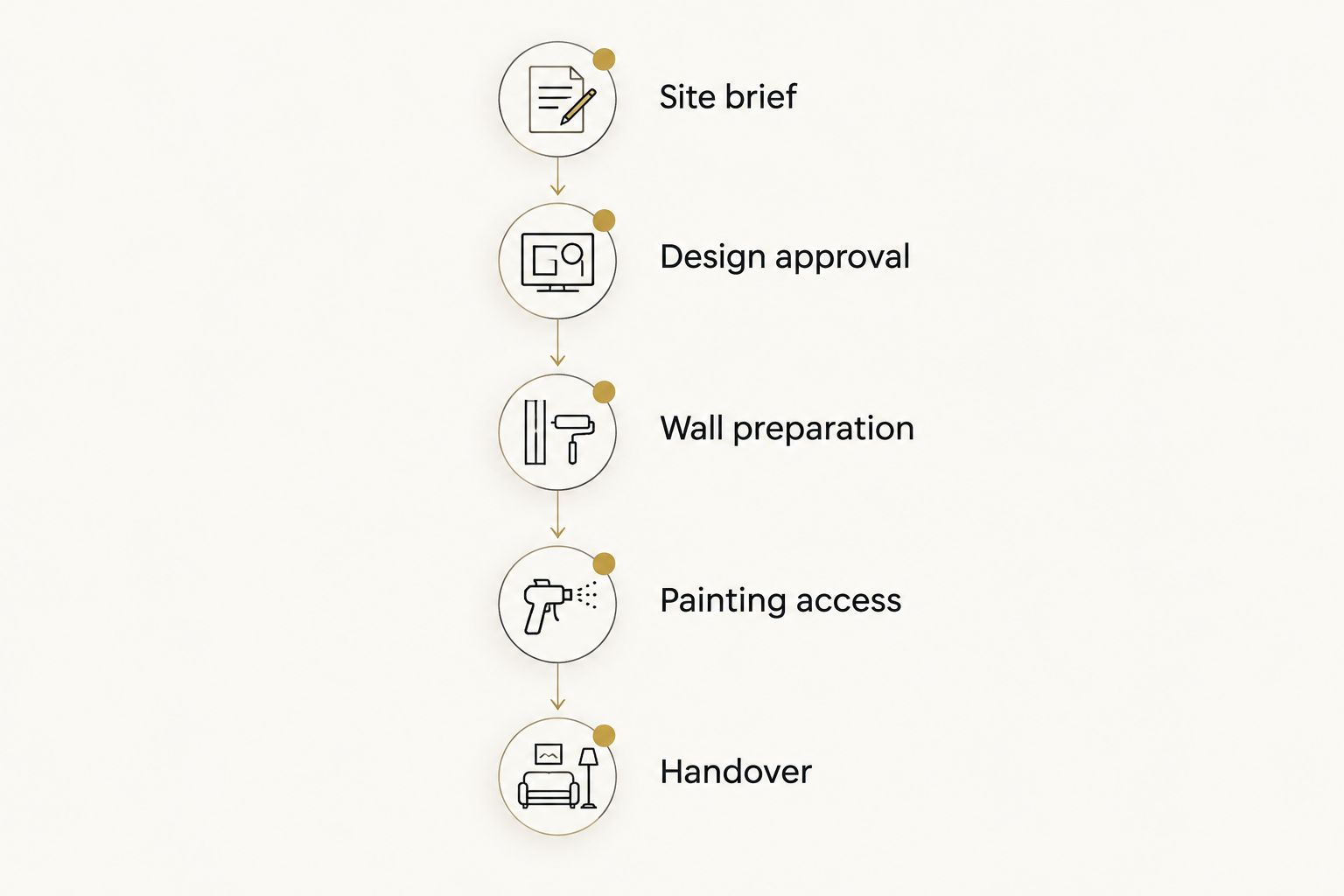
Set preparation and access responsibilities before painting begins.
The brief should make the next decision obvious. Send the actual wall, the intended concept, and the constraints together; an isolated inspiration image cannot define the commission.
Start with the actual wall
Bring the location, wall photos, concept direction, and access constraints to the commission discussion.
Which restaurant patio mural should you choose?
Choose a site-specific botanical mural if you want a clear default for a dining-first patio. Move to abstraction when the wall's main job is street-facing impact. Choose typography only when the words deserve the space.
For your 2026 commission, ARTCVLT Murals offers custom mural design and hand-painting. Set the brief around the restaurant's identity and the wall's physical conditions. Make the wall belong there.
FAQ
What's the best mural concept for a restaurant patio in 2026?
A site-specific botanical mural is the best default for a dining-first restaurant patio. Choose bold abstraction instead when the wall's main job is street-facing impact.
Is an abstract patio mural better than a botanical mural?
An abstract patio mural is better for a street-facing composition, while botanical artwork is the stronger default for framing dining. Choose according to the wall's job rather than a preferred style alone.
Should a restaurant patio mural include the restaurant name?
Include the restaurant name when lettering is central to the concept and remains readable around furniture and fixtures. A mural does not need a name or slogan to belong to the restaurant.
How do I choose a mural for a small restaurant patio?
Choose a clear composition with a visible focal point and deliberate quiet space. Check the design against tables, planters, and doors before adding fine detail.
What should I send a mural studio before commissioning patio artwork?
Send the location, wall photographs, dimensions, intended concept, and access constraints. Identify who approves the design and who is responsible for wall preparation.
Can a mural cover a damaged exterior patio wall?
A mural is not a substitute for repairing a damaged wall. Address loose coatings, moisture problems, and required repairs before agreeing to paint the surface.
How much does a custom restaurant patio mural cost?
Request a project-specific quote based on the wall, design, preparation, and access requirements. Define which responsibilities are included so you can compare proposals on the same scope.
One last thing
Check the wall after the patio is set for service. Open the umbrellas. Move the chairs into their working positions. Switch on the evening lighting.
Approve the mural against the restaurant you actually operate, not the empty patio you photographed. The best concept survives that check.