
Best overall: custom narrative illustration. Best for a name-led identity: bold typography. Best for an outdoor gathering space: botanical artwork. The best mural styles for breweries and bars in 2026 start with the venue’s character—not a trend pasted onto a wall.
TL;DR
Best mural styles for breweries and bars 2026: custom narrative illustration wins for a venue-specific focal wall.
Bold typography suits name-led bars; abstract geometry suits rooms that need visual movement without a literal story.
Botanical artwork suits patios, while surreal graphic art suits concept-driven bars with a clear creative direction.
ARTCVLT Murals designs and hand-paints custom murals; commission around the wall, viewing distance, access, and approval process.
Why this matters
A brewery mural has to work around taps, tanks, furniture, signs, and people. A bar mural has to survive a different test: what remains visible when the lights drop and the room fills? The wall is part of the room, not a separate canvas.
ARTCVLT Murals is a fit for Houston businesses commissioning custom hand-painted murals rather than off-the-shelf wall decoration. ARTCVLT Murals designs and hand-paints custom artwork for commercial buildings and private property owners.
Choose a style with a job. Give the entrance a landmark, make a long wall hold together, or put a story behind the gathering space. Trying to do all three in every square foot produces a confused brief.
What makes the best mural style for a brewery or bar?
Use these criteria to choose your direction in 2026 before approving a sketch:
Venue specificity: The artwork should belong to your brewery or bar, not any business with an empty wall.
Viewing distance: Decide whether guests encounter the mural across the room, from a seat, or from the sidewalk.
Lighting contrast: Judge the design under the lighting used during service, not just in a bright presentation.
Wall composition: Account for doors, taps, fixtures, furniture, and anything that breaks the painted surface.
Approval clarity: Name the person who approves the concept and the person who authorizes changes.
Installation fit: Confirm wall preparation, work access, and the boundary between painting and business operations.
The strongest design is not necessarily the busiest. Choose the style that gives your wall a clear role. A tightly controlled composition can carry more presence than a wall packed with unrelated references.
Brewery and bar mural styles at a glance
This 2026 comparison ranks styles by commissioning use case. Each direction has a different job; none is a substitute for a site-specific design.
1. Custom narrative illustration
Best for: A signature wall built around the venue’s identity
Standout feature: Connects characters, objects, and place in one composition
Key limitation: Needs a disciplined story brief
2. Bold typography
Best for: A bar or brewery whose name leads its identity
Standout feature: Gives lettering a dominant architectural role
Key limitation: Can become an oversized sign
3. Abstract geometry
Best for: Long walls and visually active taprooms
Standout feature: Organizes color, shape, and movement without a literal story
Key limitation: Needs custom composition to avoid generic decoration
4. Botanical artwork
Best for: Patios and indoor-outdoor gathering spaces
Standout feature: Builds a plant-led setting around the room
Key limitation: Dense detail competes with real planting and furniture
5. Heritage-inspired illustration
Best for: Venues with a documented local or brewing story
Standout feature: Makes genuine history part of the artwork
Key limitation: Requires accurate source material
6. Surreal graphic art
Best for: Concept-driven bars with a distinct creative identity
Standout feature: Uses unexpected scale and combinations as a focal point
Key limitation: Needs clear boundaries to prevent visual confusion
1. Custom narrative illustration: best for a signature venue wall
Custom narrative illustration builds a mural around the people, objects, landscape, or ideas that define your venue. It gives the artist material to interpret rather than a stack of unrelated images to copy. A brewery can start with its own story; a bar can start with a specific atmosphere or concept.
Custom narrative illustration is the strongest default for a substantial brewery or bar mural commission. It leaves room for distinctive artwork without requiring the entire wall to behave like a sign.
ARTCVLT Murals designs custom hand-painted murals. For a narrative brief, supply the venue story and separate facts that must appear from references that simply describe the mood.
Custom narrative illustration pros:
Gives the artwork a venue-specific foundation.
Supports a focal composition with smaller discoveries nearby.
Lets the design account for interruptions in the wall.
Custom narrative illustration cons:
Too many story elements weaken the central idea.
Small narrative details lose their role at long viewing distances.
Best for: Owners who want one signature wall to express what makes the venue different.
Verdict: Buy custom narrative illustration when you can name the story and leave room for interpretation.
2. Bold typography: best for a name-led brewery or bar
Bold typography makes lettering the artwork’s main structure. The words can be the venue name or another approved piece of language, with scale, spacing, and painted form doing the visual work. The brief needs an exact text decision before detailed design begins.
Keep the distinction clear: a typographic mural is an artwork built from words. It is not an excuse to stretch an existing logo until it fills the wall.
Bold typography pros:
Gives the mural a clear verbal focal point.
Suits a brief with one dominant name or phrase.
Supports strong composition without a dense illustrated story.
Bold typography cons:
Unapproved wording can trigger substantial redesign.
Decorative lettering can lose readability in dim light.
Best for: Venues whose name deserves to lead the room rather than sit quietly above the door.
Verdict: Buy bold typography when the wording is settled and the lettering will be designed for the wall.
3. Abstract geometry: best for long, visually active taprooms
Abstract geometry uses shape, repetition, and color relationships rather than a literal scene. It works as a direction for walls that need movement without another set of characters or objects competing with equipment and furniture. The composition should respond to the room’s architecture.
Start by deciding where the eye should land. A geometric mural still needs hierarchy; repeating the same visual intensity from end to end gives every part of the wall equal weight.
Abstract geometry pros:
Does not depend on a written venue story.
Gives the artist room to work around wall breaks.
Supports a deliberate connection between painted areas and open space.
Abstract geometry cons:
A generic pattern says little about the venue.
Strong shapes can compete with menus and directional signs.
Best for: Taprooms with long walls, exposed equipment, or an interior that already carries plenty of objects.
Verdict: Buy abstract geometry when spatial composition matters more than a literal narrative.
4. Botanical artwork: best for patios and indoor-outdoor spaces
Botanical artwork builds its composition around plants, leaves, branches, or flowers. Use it to frame a gathering area rather than cover every visible surface with foliage. The design should account for real planters, umbrellas, furniture, and the way guests approach the wall.
For a Houston commission in 2026, decide whether local plant references are part of the brief or whether the artwork is intentionally imaginative. Do not describe decorative plants as locally native without confirming the species.
Botanical artwork pros:
Gives patios a clear subject without relying on lettering.
Supports framing around doorways and seating areas.
Offers a visual connection between indoor and outdoor spaces.
Botanical artwork cons:
Dense foliage can disappear behind real planting.
Fine detail becomes difficult to read from distant seats.
Best for: Breweries and bars with patios or gathering spaces that connect directly to the outdoors.
Verdict: Buy botanical artwork when the composition respects the furniture and planting already in place.
5. Heritage-inspired illustration: best for a documented venue story
Heritage-inspired illustration draws from genuine history: the building, neighborhood, founders, or brewing practices relevant to the business. Its strength comes from specific source material, not an invented vintage identity. Supply approved photographs, dates, names, and references before the artist develops the story.
Keep nostalgia on a short leash. Borrowed historical imagery can make a new venue look like it is claiming a past it does not have.
Heritage-inspired illustration pros:
Gives documented history a visible place in the venue.
Provides concrete material for the design brief.
Supports an illustrated story beyond the business name.
Heritage-inspired illustration cons:
Historical details require verification and approval.
A crowded timeline can read like an exhibit instead of a mural.
Best for: Venues with a real, relevant story and someone responsible for checking its accuracy.
Verdict: Hold heritage-inspired illustration until the historical references are verified and cleared for use.
6. Surreal graphic art: best for concept-driven bars
Surreal graphic art combines recognizable subjects in unexpected ways. Altered scale, unusual settings, and deliberate visual contradictions make the concept the focal point. This direction needs a clear creative boundary, not instructions to make the wall random.
Name the intended atmosphere and the imagery that is off-limits. That gives the artist space to create without making every design review a debate over what the venue stands for.
Surreal graphic art pros:
Gives a concept-led venue room for an unexpected statement.
Supports a dominant image rather than scattered decoration.
Allows familiar subjects to take on a different character.
Surreal graphic art cons:
Competing visual ideas can make the composition hard to follow.
Unsettled subject boundaries can stall design approval.
Best for: Bars with a defined creative concept and a decision-maker comfortable approving unconventional artwork.
Verdict: Buy surreal graphic art when the concept is specific and the approval authority is clear.
Turn the style choice into a commission brief
A style name is not a scope. Before commissioning a brewery or bar mural in 2026, resolve the decisions that affect design, preparation, and painting access. Use this sequence to keep the project concrete.
Site review
Send the location, wall photographs, dimensions, and photographs of nearby fixtures. Include 3 viewing positions: the entrance, the main seating area, and the closest unobstructed approach. These are briefing checkpoints, not required installation measurements.
Identify wall damage, existing coatings, and signs of moisture for assessment. Establish who handles preparation before the painting scope is agreed. Artwork does not replace a sound painting surface.
Creative brief
Choose one primary job for the mural. Then name the style, the required content, and the references that explain the atmosphere. Separate inspiration from instructions to reproduce someone else’s artwork.
For a substantial commission, settle the site requirements before discussing scope. The guide to how much a custom mural costs is a useful next step for that conversation.
Design approval
Set 2 approval gates: concept direction and final composition. Confirm that arrangement with the commissioned artist rather than assuming it is included in a particular service. Appoint 1 decision owner to consolidate comments from partners, managers, or building representatives.
Check the final composition against the actual wall. Confirm wording, subject matter, placement, and anything that equipment or furniture will cover.
Access plan
Document how the painting area will be reached and separated from guests and staff. Address operating hours, equipment movement, deliveries, and any work at height with the responsible parties. For exterior walls, confirm property-owner consent and whether local approvals apply before setting the work plan.
The access plan belongs beside the design. A wall that cannot be reached as planned is not ready for painting.
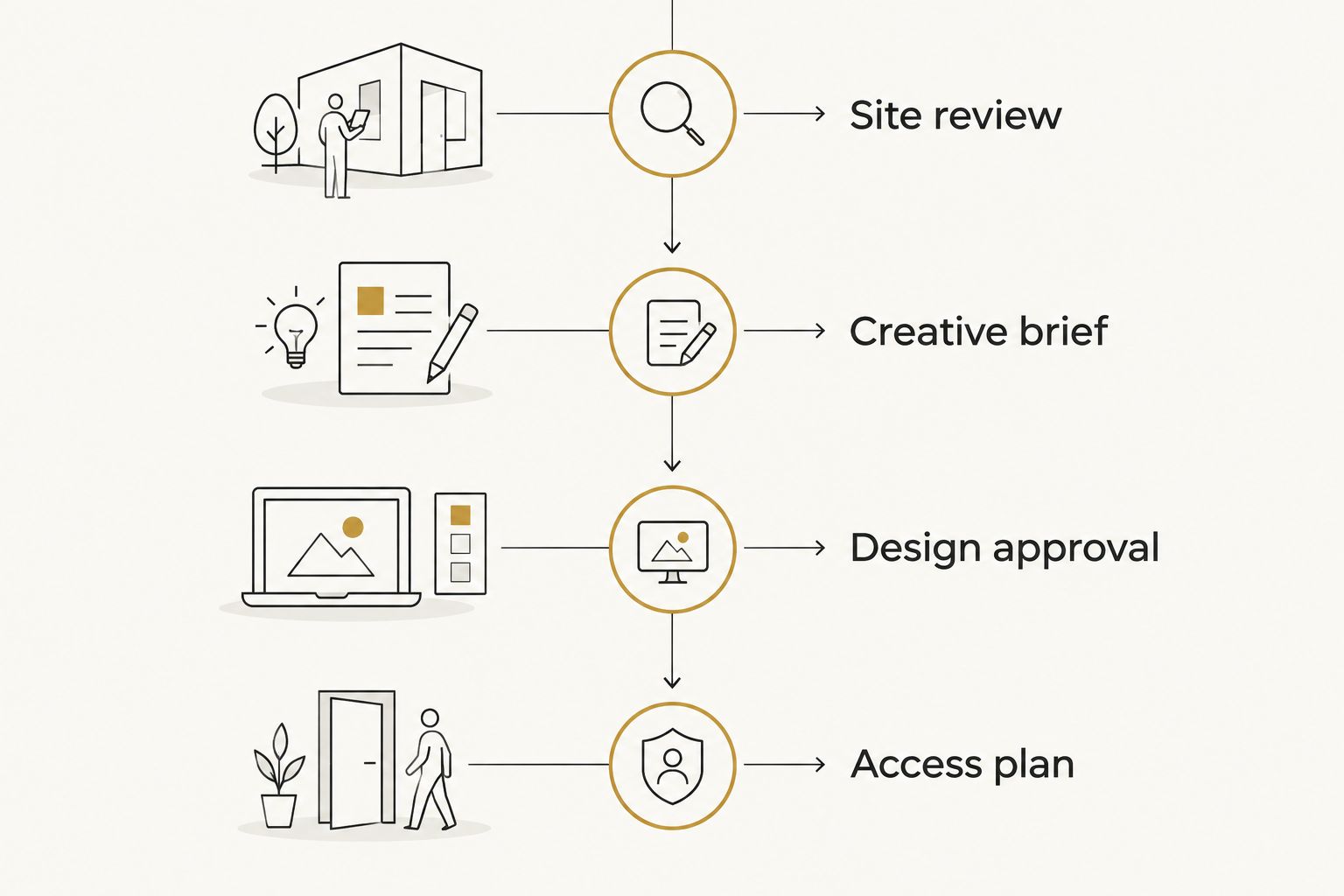
Resolve the wall, the artwork, the approvals, and the access before painting begins.
Bring the wall and the brief together. A strong concept needs an agreed surface, an approved composition, and a workable installation boundary—not just enthusiasm for a reference image.
Give the wall a direction
Bring the location, wall photos, intended style, and project goals to the commissioning conversation.
How these mural styles were ranked
This 2026 ranking prioritizes venue specificity, viewing distance, lighting, wall composition, approval clarity, and installation fit. It is a commissioning guide, not a popularity chart. Custom narrative illustration leads because it gives a venue-specific brief the widest expressive role; the other styles win when their narrower use case matches the wall.
Which mural style should you choose?
Choose custom narrative illustration if you want a signature brewery or bar wall and have not settled on a direction. Start with what belongs to the venue, then let the composition respond to the room.
Choose bold typography when the name is the statement. Choose abstract geometry when the architecture needs visual movement. Choose botanical artwork for an outdoor-led setting, heritage-inspired illustration for a verified story, and surreal graphic art for a defined concept.
For a Houston commission in 2026, ARTCVLT Murals offers custom hand-painted murals. Bring a clear purpose—not a demand to copy a wall from somewhere else.
FAQ
What’s the best mural style for a brewery or bar in 2026?
Custom narrative illustration is the best default for a brewery or bar seeking a venue-specific signature wall. Bold typography, abstract geometry, botanical artwork, heritage-inspired illustration, and surreal graphic art suit more specific briefs.
Is a typographic mural better than an illustrated mural?
Bold typography is better when the venue name or approved wording is the main statement. Custom narrative illustration is better when the wall needs to express a story through imagery rather than lettering.
What mural style works for a dimly lit bar?
Choose a composition with a clear focal point and contrast that remains readable under the bar’s service lighting. Assess the design in the actual lighting conditions rather than relying on a bright digital presentation.
What should I send an artist before commissioning a brewery mural?
Send the location, wall dimensions, photographs, project goals, and preferred style. Include wall-condition concerns, fixtures, viewing positions, access restrictions, and the person responsible for design approval.
How much does a custom brewery or bar mural cost?
A custom brewery or bar mural requires a project-specific quote. Define the wall area, design scope, preparation responsibilities, access requirements, and working conditions before comparing proposals.
Can botanical artwork work on a brewery patio?
Botanical artwork is a strong direction for a brewery patio when it frames the gathering space rather than competing with it. Account for real plants, umbrellas, furniture, and exterior wall conditions in the brief.
Does ARTCVLT Murals create custom murals for commercial properties?
ARTCVLT Murals designs and hand-paints custom murals for commercial buildings and private property owners. The studio is based in Houston, Texas.
One last thing
Approve the wall with furniture in the picture. A composition that looks complete on an empty elevation can lose its focal point behind a booth, tap system, or open door.
Before final approval, mark those obstructions on the wall photograph and review the artwork from the entrance. Make the visible wall count. That is where blank wall becomes landmark.