
Best overall: place-based abstraction. Best for intimate lounges: botanical compositions. Best for story-led hotels: local-history murals. The best mural designs for hotel lobbies in 2026 give the property a distinct identity without fighting reception, lighting, or the architecture. These 6 design directions help you choose what belongs on the wall—and what does not.
TL;DR
Best mural designs for hotel lobbies 2026: choose place-based abstraction for a distinct arrival wall.
ARTCVLT Murals designs and hand-paints custom murals for commercial buildings in Houston.
Botanical compositions suit intimate lounges; local-history murals suit properties with a specific story.
Approve the composition, wall preparation, and painting access before work begins.
Why this matters
A hotel lobby wall sits inside a working space. Guests arrive with luggage. Staff need clear sightlines. Furniture, signs, and lighting share the same visual field. A mural must belong to that room, not just look good in a cropped photograph.
ARTCVLT Murals is a fit for Houston hotel buyers commissioning custom, hand-painted lobby artwork. ARTCVLT Murals designs and hand-paints custom murals for commercial buildings and private property owners. For your commission, start with the wall, the guest experience, and the property's identity—not a borrowed image.
What makes the best hotel lobby mural design?
Use these criteria to choose your direction before approving a sketch:
Place: The artwork expresses something specific about the property or its setting, rather than interchangeable hotel décor.
Architectural fit: The composition works around doors, columns, ceiling changes, reception desks, and built-in fixtures.
Viewing distance: The main idea reads from the entrance, while closer details reward guests who stop.
Visual hierarchy: The mural gives the room a focal point without obscuring reception or competing with essential signs.
Surface fit: The proposed design accounts for wall texture, existing coatings, damage, and preparation.
Commission clarity: You can approve the artwork, define painting access, and assign responsibility for the wall before installation.
For a 2026 hotel project, rank architectural fit above resemblance to a reference photo. You are commissioning a wall, not buying an image.
Hotel lobby mural designs at a glance
1
Design direction: Place-based abstraction
Best for: A distinctive main arrival wall
Standout feature: Local references translated into an original composition
Key limitation: Becomes generic when the references are vague
2
Design direction: Botanical composition
Best for: An intimate lobby lounge
Standout feature: Organic forms that can frame seating
Key limitation: Dense foliage can compete with furnishings
3
Design direction: Local-history narrative
Best for: A story-led property
Standout feature: Artwork built around a documented subject
Key limitation: Requires research and subject approval
4
Design direction: Architectural geometry
Best for: A lobby with strong structural lines
Standout feature: Shapes organized around the room itself
Key limitation: Hard edges expose alignment problems
5
Design direction: Panoramic landscape
Best for: A broad wall facing seating
Standout feature: A continuous scene across the wall
Key limitation: Furniture and openings can interrupt the scene
6
Design direction: Typographic landmark
Best for: A hotel with a clear verbal identity
Standout feature: A short phrase becomes the visual anchor
Key limitation: Competes with signs and dates when wording changes
1. Place-based abstraction: best for a main arrival wall
Place-based abstraction translates a location into shape, rhythm, and color rather than reproducing a postcard view. Your references might come from the property's architecture, nearby landscapes, or a documented detail of its setting. The finished composition needs its own identity.
For a Houston hotel, decide which local reference matters to the property. Do not pile every recognizable motif onto one wall. A focused brief gives the artist something to interpret instead of a checklist to illustrate.
Place-based abstraction pros:
Gives you a clear route toward original, site-specific artwork.
Allows the composition to work around architectural interruptions.
Supports a strong distant read with detail at closer range.
Place-based abstraction cons:
Vague direction produces vague artwork.
An abstract concept needs a clear explanation during design approval.
Uncontrolled color changes can disconnect the mural from the room.
Best for: A main arrival wall that should establish the hotel's identity immediately.
Buy: Choose place-based abstraction when you want a landmark wall without literal scenery or a wall-sized slogan.
2. Botanical composition: best for an intimate lobby lounge
A botanical mural uses leaves, branches, flowers, or plant silhouettes to shape the wall. The strongest direction responds to the furniture below it. Forms can frame a seating group, rise behind a banquette, or leave open space around a lamp.
Choose the level of detail deliberately. A close-view lounge wall can support intricate linework; a wall seen across the lobby needs a simpler structure. Neither approach requires covering every inch with foliage.
Botanical composition pros:
Organic shapes can soften the visual effect of straight architectural lines.
The composition can wrap around seating and fixtures.
Plant forms offer both graphic and detailed design directions.
Botanical composition cons:
Generic tropical imagery weakens a property-specific brief.
Dense patterns can clash with upholstery and decorative lighting.
Literal plant selections need checking when local accuracy matters.
Best for: A lounge or waiting area where guests see the artwork at close range.
Buy: Choose botanical artwork when the seating area needs a composed backdrop. Skip it when the room already carries competing patterns.
3. Local-history narrative: best for a story-led hotel
A local-history mural builds the artwork around a documented event, place, community, or architectural story. It gives the wall a subject beyond decoration. That subject must be accurate, relevant, and appropriate for a public-facing hotel space.
Separate the source material from the artistic interpretation. Confirm names, imagery, permissions, and the intended story before approving the composition. Historic photographs and community stories are not interchangeable mood-board material.
Local-history narrative pros:
Gives the property a specific story to communicate.
Creates opportunities for details guests can examine closely.
Connects the commission to an identifiable subject.
Local-history narrative cons:
Research and permissions add approval work.
Too many scenes or figures make the composition difficult to read.
Sensitive subjects require informed review before painting.
Best for: A property with a documented story and people authorized to approve its treatment.
Buy: Choose a history-led mural when the subject is central to the hotel. Wait when the facts or permissions remain unresolved.
4. Architectural geometry: best for a structured lobby
Architectural geometry uses lines, planes, repeated shapes, and deliberate shifts in scale. Its organizing idea comes from the room. A column, ceiling break, or reception desk can establish where the composition starts and stops.
This direction works best when the painted geometry has a clear relationship to the building. Random shapes do not become site-specific just because they occupy a large wall. Ask to see the composition placed against the actual openings and fixtures.
Architectural geometry pros:
Gives a strong framework to a wall without a literal subject.
Can align with existing architectural features.
Supports controlled use of color and open space.
Architectural geometry cons:
Uneven surfaces make precise edges harder to execute.
Poor alignment becomes conspicuous beside straight building lines.
Excessive repetition can turn the artwork into background pattern.
Best for: A lobby where structural lines should guide the artwork.
Buy: Choose geometry when the room supplies the composition. Skip it when exact alignment is essential but the wall cannot support it.
5. Panoramic landscape: best for a broad seating-facing wall
A panoramic landscape presents a continuous scene across a wall: terrain, water, sky, or another setting relevant to the property. It offers a recognizable subject without requiring text. The layout depends on where guests actually see it.
Locate the horizon and focal elements on the wall elevation before approval. A chair back can obscure a foreground detail; a doorway can cut through the central subject. Design around those interruptions instead of discovering them after painting.
Panoramic landscape pros:
Gives a broad wall a continuous visual subject.
Offers a clear connection to a selected setting.
Allows differences in detail between foreground and distance.
Panoramic landscape cons:
Doors and furniture can break the scene.
Literal scenery needs accuracy when it depicts a real location.
A generic view contributes little to the hotel's identity.
Best for: A broad wall with a stable furniture layout and a clear viewing position.
Buy: Choose a landscape when the wall can carry the scene intact. Wait until the seating layout is settled.
6. Typographic landmark: best for a clear verbal identity
A typographic mural makes a short phrase, name, or message the main visual element. Lettering becomes artwork through scale, placement, and composition. The words still have to earn their space.
Keep decorative lettering separate from essential wayfinding. Guests should not have to distinguish a painted statement from directions to reception. For a 2026 commission, approve the exact wording with the person responsible for the hotel's identity before refining the letterforms.
Typographic landmark pros:
Makes a specific message the focal point.
Gives the approval team a clear subject to assess.
Allows lettering to respond to the wall's proportions.
Typographic landmark cons:
Wording changes require changes to the artwork.
Lettering competes easily with nearby signs.
Long messages turn a landmark into a reading assignment.
Best for: A hotel with settled wording and a wall separate from operational signage.
Buy: Choose typography when the message belongs to the property. Skip generic hospitality slogans.
How these designs are ranked
Place-based abstraction ranks first because it gives a custom commission a distinct subject while leaving room to respond to architecture. The remaining directions each answer a narrower brief: intimate seating, documented history, structural lines, a continuous scene, or a verbal identity.
These are commissioning recommendations, not measured guest-response results. A room-specific design decision takes priority over the order of the list.
Commission the wall, not just the concept
Before you commission a hotel lobby mural in 2026, give the artist enough information to design for the real space. Send the location, wall photographs, dimensions, intended viewing positions, and the purpose of the artwork. Tell the artist what must remain visible.
Use these 5 checkpoints to keep the brief concrete:
Site brief: Identify the wall, the audience, the subject, and the people authorized to approve the work.
Wall assessment: Establish the surface condition, existing coatings, repairs, and who handles preparation.
Design approval: Approve the composition on a wall elevation that includes permanent fixtures and planned furniture.
Painting access: Agree on workspace, equipment access, protection, and separation from guest circulation.
Final review: Check the completed artwork against the approved design and record care guidance supplied for the finished surface.
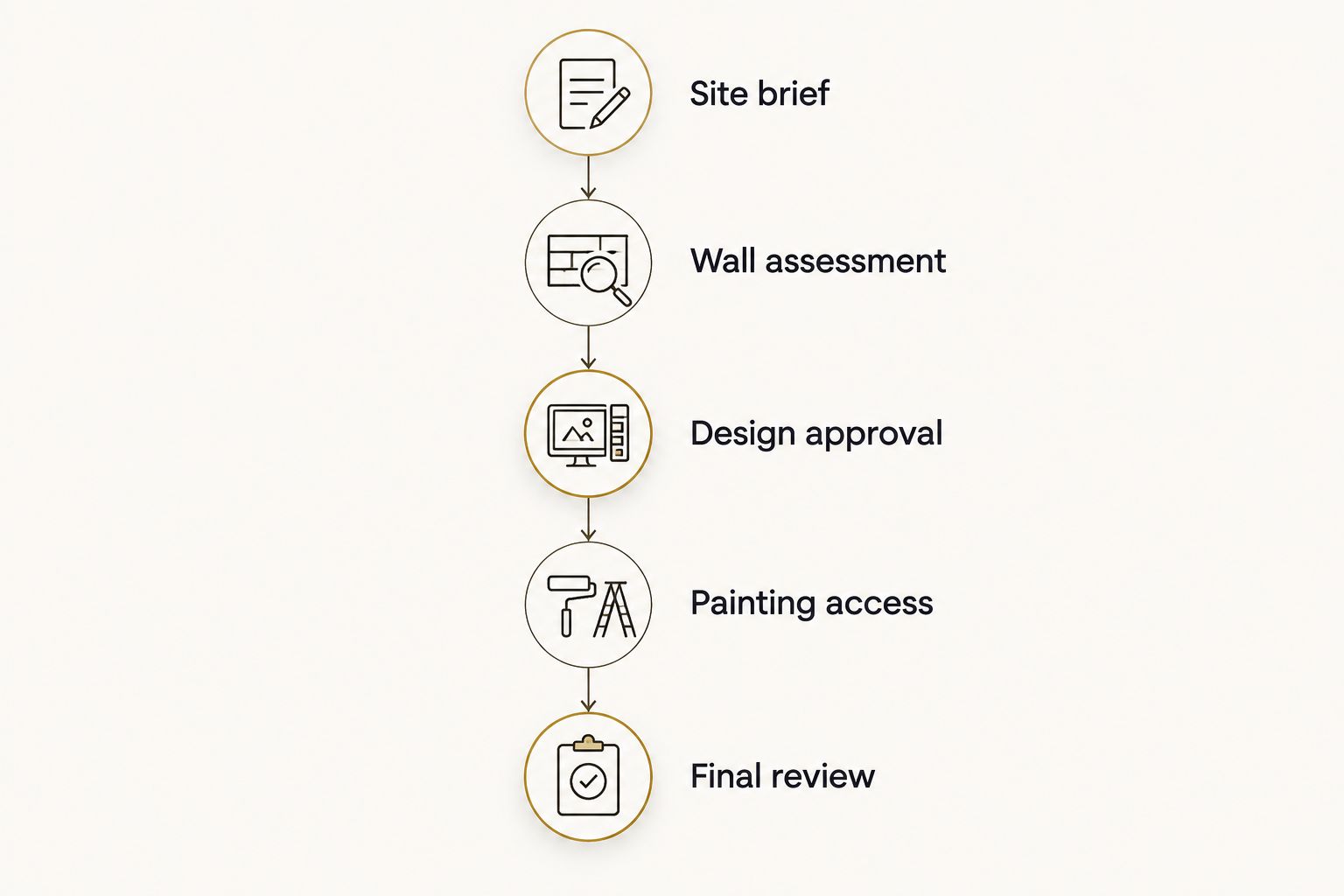
Approve the wall conditions and painting access as well as the artwork.
Keep 2 approvals separate: design approval and site readiness. A signed-off sketch does not establish that repairs are complete or that painters can safely occupy the lobby. Assign responsibility for both before setting the painting schedule.
An operating hotel also needs a practical access plan. Identify which guest routes must stay open and which furniture or fixtures need protection. Confirm any building-management requirements with the people responsible for the property.
ARTCVLT Murals creates custom hand-painted murals. Bring the studio a specific wall and a specific goal; let the artwork respond to both.
Give the wall a direction
Start with the location, wall photos, project scope, and the identity you want the artwork to express.
Which hotel lobby mural should you choose?
Choose place-based abstraction as the default for a main arrival wall. It gives you a route toward distinctive artwork without requiring historical storytelling, literal scenery, or a permanent written message.
Choose botanical work for the lounge, history for a documented property story, geometry for architectural order, landscape for a broad uninterrupted scene, and typography for settled wording. For your 2026 brief, pick the direction that fits the room—not the image that looks strongest in isolation.
FAQ
What's the best mural design for a hotel lobby in 2026?
Place-based abstraction is the recommended default for a main arrival wall. It translates references from the property's setting into a custom composition that can respond to the architecture.
Is a botanical mural better than an abstract mural for a hotel lounge?
A botanical mural is the stronger choice when organic forms suit the lounge furniture and the artwork will be viewed closely. Choose place-based abstraction when establishing a distinct property identity is the main priority.
Can a hotel lobby mural include local history?
Yes, a hotel lobby mural can depict a documented local story. Confirm the facts, image permissions, and people authorized to approve the subject before painting.
What should I send a mural artist before requesting a proposal?
Send the location, wall photographs, dimensions, project purpose, and intended viewing positions. Include furniture plans, known wall problems, and any restrictions on painting access.
Can a mural be painted while the hotel remains open?
An occupied-lobby project needs an agreed access and protection plan before scheduling. Confirm guest routes, work-area separation, equipment access, and building-management requirements with the responsible team.
How should I approve a hotel lobby mural design?
Approve the design on a wall elevation showing doors, fixtures, signage, and planned furniture. Keep artwork approval separate from confirmation that the wall and workspace are ready.
Does ARTCVLT Murals create custom commercial murals in Houston?
ARTCVLT Murals is a Houston, Texas-based studio that designs and hand-paints custom murals for commercial buildings and private property owners. Define the hotel wall, scope, and intended design direction when discussing a commission.
One last thing
Check the proposed mural from 3 viewing positions: the entrance, reception, and seated eye level. These are review positions, not design measurements. Each reveals a different relationship between the artwork and the room.
A composition can look complete on a clear wall elevation and lose its central detail behind a chair. Catch that before paint touches the wall. Make the wall a landmark. Keep the lobby working.