
Best overall: a custom nature landscape. Best for arrival areas: a neighborhood scene. Best for an exterior identity wall: bold abstract artwork. The best mural ideas for daycare centers in 2026 start with the room’s purpose—not a catalog of cute characters. This guide ranks six hand-painted concepts for a commercial commission.
TL;DR
The best mural ideas for daycare centers 2026 start with custom nature landscapes for shared classrooms.
Choose neighborhood scenes for arrival areas and botanical artwork for reading corners.
ARTCVLT Murals designs and hand-paints custom murals; commission original artwork around your building and its use.
Approve the design, wall preparation, and installation access before painting begins.
Why this matters
A daycare mural shares space with furniture, classroom displays, storage, and daily activity. The wall must work inside that reality. A beautiful sketch that disappears behind cubbies is the wrong design.
For Houston owners commissioning substantial artwork in 2026, start with the building and the brief. ARTCVLT Murals is a Houston-based studio that designs and hand-paints custom murals for commercial buildings and private property owners.
ARTCVLT Murals is a fit for daycare owners commissioning a custom hand-painted mural, rather than buying ready-made wall decoration. Give the artwork a clear job: define the entrance, anchor a classroom, or turn an exterior wall into a landmark.
What makes the best daycare mural
Judge each concept against these criteria before choosing a theme:
Room purpose: Match the artwork to arrival, reading, movement, classroom activity, or exterior identity.
Clear composition: Give the wall a focal point. Leave room for the objects and displays that already occupy it.
Original artwork: Commission a visual language specific to your center instead of borrowing recognizable entertainment characters.
Wall readiness: Assess the surface condition and agree on preparation responsibilities before painting.
Installation access: Plan around children, staff, equipment, entrances, and the areas that must stay in use.
Approval control: Name the decision-maker and settle the composition before the artist reaches the wall.
The strongest idea survives all six checks. If a concept only works on an empty wall in a presentation, revise it.
Daycare mural ideas at a glance
These are commissioning directions, not off-the-shelf products. The ranking gives each concept a separate job.
1. Custom nature landscape
Best for: Shared classrooms
Standout feature: A connected scene that can frame existing furniture
Key limitation: Too much detail competes with classroom displays
2. Neighborhood scene
Best for: Arrival and reception
Standout feature: Buildings and pathways organize an entrance wall
Key limitation: Literal details require careful approval
3. Botanical study
Best for: Reading corners
Standout feature: Leaves and branches support a restrained composition
Key limitation: Repetition alone can feel like wallpaper
4. Ocean journey
Best for: Long circulation walls
Standout feature: A continuous scene connects separate wall sections
Key limitation: Doors and signs can interrupt the artwork
5. Space exploration
Best for: Older-child project areas
Standout feature: Planets and orbital forms create a distinct activity backdrop
Key limitation: Educational labels add accuracy checks
6. Bold abstract identity
Best for: Exterior landmark walls
Standout feature: Large shapes establish an original visual signature
Key limitation: Artwork alone does not identify the business
1. Custom nature landscape: best for shared classrooms
A landscape uses trees, hills, water, and original animal imagery to build one connected scene. It gives the artist room to adjust the composition around shelves, doors, and teaching areas without turning every available surface into a separate illustration.
For a 2026 commission, choose a clear focal point and keep secondary details subordinate. Let the wall breathe. You do not need an animal in every gap.
Nature landscape pros:
Adapts to wide or interrupted classroom walls.
Allows a distinct palette without relying on licensed characters.
Can leave open areas around teaching displays.
Nature landscape cons:
Dense scenes compete with materials added later.
Furniture changes can cover important details.
Best for: A shared classroom that needs one strong visual anchor.
Verdict: Buy this direction as the default, then design around the actual room.
2. Neighborhood scene: best for arrival and reception
A neighborhood mural turns buildings, pathways, gardens, and gathering places into a welcoming entrance composition. Keep it original. The artwork can suggest a community without pretending to document a real street.
Place the main scene where arriving families can see it, not behind the reception desk. Decide early whether any depicted locations are fictional or require a specific likeness.
Neighborhood scene pros:
Gives the arrival wall a clear subject.
Offers distinct areas for large and small details.
Can frame doorways as part of the composition.
Neighborhood scene cons:
Requested real-world likenesses add approval work.
Too many buildings make the wall feel crowded.
Best for: Reception areas where the mural introduces the center’s character.
Verdict: Buy for arrival spaces; skip literal street-map detail unless it serves the brief.
3. Botanical study: best for reading corners
A botanical mural focuses on leaves, branches, flowers, and broad areas of color rather than a full narrative scene. Use scale and spacing to give the reading area its own identity.
A restrained design does not need to be timid. One large branch or a strong leaf silhouette can carry the wall without covering every inch. Judge the composition with bookshelves and seating in place.
Botanical study pros:
Works as a focused backdrop rather than a full-room theme.
Leaves space for shelving and reading materials.
Supports original shapes and color combinations.
Botanical study cons:
Repeated motifs can resemble generic decoration.
Fine details lose impact behind furniture.
Best for: Reading corners and smaller spaces that need a defined backdrop.
Verdict: Buy for a focused reading area; skip all-over repetition without a focal point.
4. Ocean journey: best for long circulation walls
An ocean mural can move from shoreline imagery into underwater forms across a corridor. Treat the wall as a sequence, not a pile of unrelated sea creatures.
Map doors, safety signs, and wall-mounted equipment before drawing the scene. Keep essential information separate from the artwork. A mural must not disguise the things people need to find.
Ocean journey pros:
Gives a long wall a connected visual direction.
Accommodates distinct scenes between doors.
Offers clear changes in scale and depth.
Ocean journey cons:
Frequent openings interrupt continuity.
Heavy detail becomes clutter in a narrow passage.
Best for: Circulation walls with enough visible surface to connect the scenes.
Verdict: Buy for a long corridor; skip if signage and openings leave only scattered fragments.
5. Space exploration: best for older-child project areas
Planets, moons, orbital paths, and imagined spacecraft give a project room a clear subject. Decide whether the mural is expressive artwork or an educational diagram before design approval.
That distinction matters. If you request scientific names, relationships, or scale, assign someone to check them. Do not ask decorative artwork to carry unreviewed teaching content.
Space exploration pros:
Establishes a distinct project-area identity.
Supports large forms with open space between them.
Allows original imagery without branded characters.
Space exploration cons:
Labels create additional review obligations.
A dark, dense composition can dominate a small room.
Best for: Older-child activity spaces with a clear creative or learning brief.
Verdict: Buy for a dedicated project area; hold until educational content is approved.
6. Bold abstract identity: best for exterior landmark walls
Large shapes, strong edges, and an original composition can turn a daycare exterior into a recognizable piece of artwork. This is an identity commission, not a requirement to paint a mascot larger.
For an exterior mural in 2026, assess sightlines, wall condition, access, and the relationship to existing signs. Keep the business name readable through its own approved signage; do not expect abstract artwork to explain the address or entrance.
Abstract identity pros:
Creates an original visual signature.
Uses large forms that do not depend on tiny details.
Avoids locking the building into a single illustrated story.
Abstract identity cons:
Needs a precise brief to avoid generic shapes.
Does not replace identification or directional signs.
Best for: Owners commissioning an exterior landmark rather than a classroom scene.
Verdict: Buy for a substantial exterior identity project; skip as a substitute for signage.
How these mural ideas rank
Nature landscapes take the default slot because the concept can accommodate classroom furniture, open areas, and a connected composition. The other ideas win on a specific placement—not because they are universally better.
This is a design-fit ranking for 2026 commissioning decisions. Room purpose, composition, originality, wall readiness, access, and approval control determine the order. No theme earns a claim about learning outcomes simply because it looks appealing.
Commission the mural before you commit to the theme
A strong concept needs a workable scope. Use this sequence to turn an idea into a commission brief for ARTCVLT Murals or another mural artist.
Site brief
Send the location, wall photographs, measurements, and the room’s purpose. Include doors, windows, shelving, outlets, signs, and equipment—not just a cropped picture of blank paint.
Identify what stays and what moves. Describe whether the commission covers one wall, several rooms, or an exterior surface. Separate the desired artwork from any building work.
Design approval
Choose 1 approval lead to gather feedback and return a single decision. Establish 2 approval stages: the concept direction first, then the final composition and palette.
Ask who owns the final sign-off, how revisions are handled, and what happens if the brief changes. Resolve those questions before installation. Conflicting comments should not become the artist’s job to arbitrate on site.
Wall preparation
Confirm who assesses and prepares the surface. Ask how existing coatings, cracks, damp areas, and damaged sections will be addressed before artwork begins.
Do not treat paint as a repair plan. If the wall has an unresolved building issue, address the issue rather than asking the mural to hide it.
Installation access
Define the work area, equipment access, and separation from occupied spaces. Confirm responsibility for moving furniture and protecting nearby surfaces.
Discuss operating hours and any closure arrangements with the artist. The written schedule should reflect the agreed scope—not an assumed painting duration.
Handover
Agree on what completion means and who accepts the finished work. Request care instructions for the actual materials used and clarify how future damage or alterations will be handled.
Keep the approved artwork and scope together. They give you a clear reference if someone later proposes mounting a cabinet through the focal point.
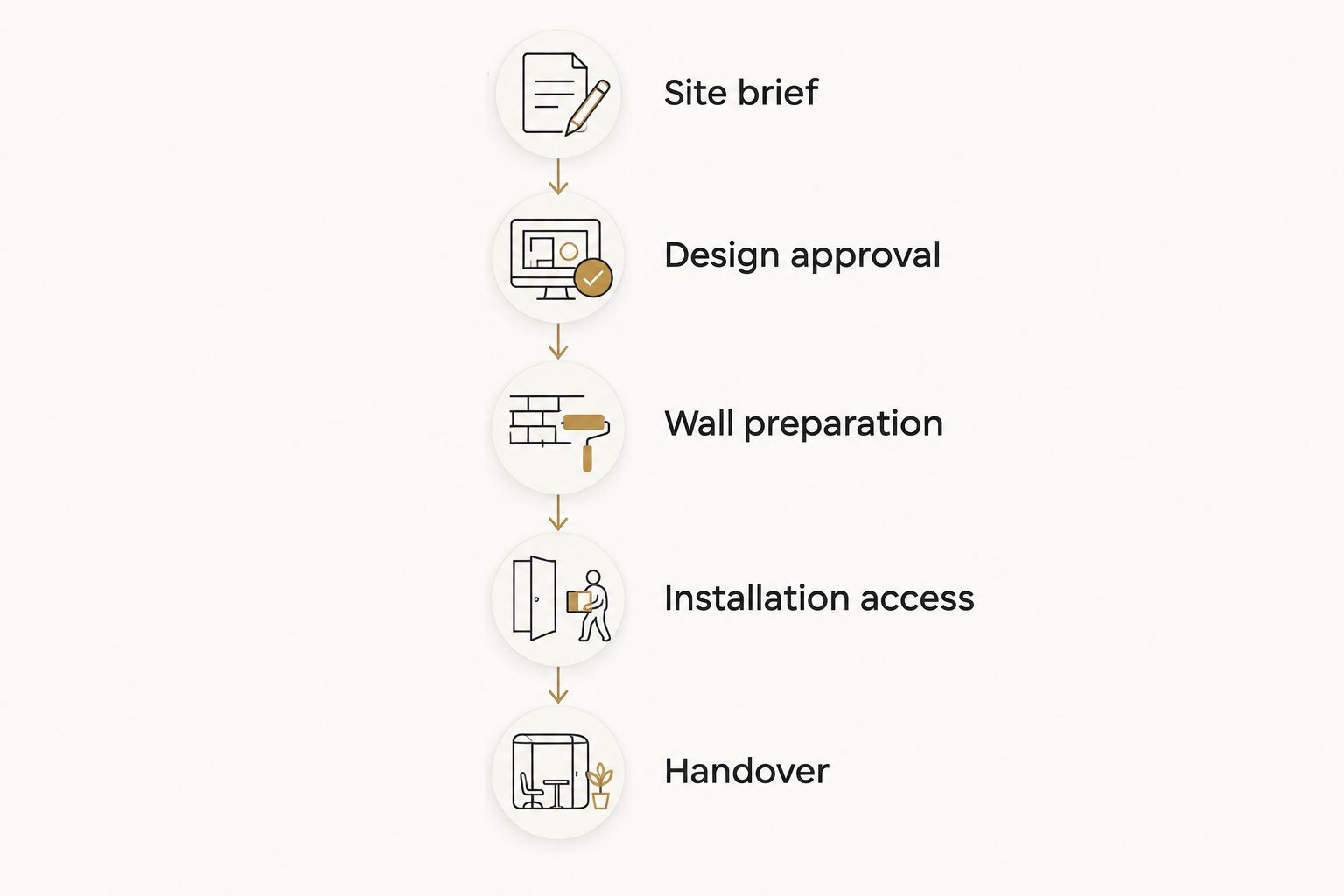
Approve the artwork and the installation conditions before painting begins.
The budget discussion belongs beside the scope. Review custom mural cost factors before requesting a proposal, then ask what preparation, access, design work, and finishing responsibilities the quote includes.
Make the wall count
Bring your location, wall photos, room purpose, and approval requirements to the mural discussion.
Which daycare mural should you choose?
Choose a custom nature landscape if you need one dependable direction for a shared classroom. Choose a neighborhood scene for arrival, botanical artwork for reading, an ocean sequence for circulation, or space imagery for a dedicated project area.
For a building-level statement, choose an abstract exterior commission. Different wall. Different job. Do not stretch a classroom theme across the entire property just to make everything match.
The best mural ideas for daycare centers in 2026 become useful when the placement, approval process, and installation scope are settled. Pick the concept that fits your wall, then give the artist a clear brief.
FAQ
What’s the best mural idea for a daycare classroom?
A custom nature landscape is the strongest default for a shared daycare classroom. Design the scene around furniture, teaching displays, and a clear focal point rather than filling every available space.
Is a hand-painted daycare mural better than wallpaper?
Choose a hand-painted mural when you want original artwork designed around a specific wall. Wallpaper serves a different brief: a repeated or ready-made design rather than a site-specific painted composition.
Who paints custom daycare murals in Houston?
ARTCVLT Murals is a Houston-based studio that designs and hand-paints custom murals for commercial buildings and private property owners. Describe the daycare location, wall, and intended use when discussing a commission.
What should I send a mural artist before requesting a quote?
Send the location, wall photographs, measurements, intended use, and project scope. Include access restrictions, surface concerns, and the person responsible for design approval.
Can we include famous cartoon characters in a daycare mural?
Use original artwork unless the necessary permission for protected characters has been confirmed. Agree on that responsibility before design work begins rather than assuming a commission includes permission.
How do we plan mural installation while the daycare operates?
Agree on work-area separation, equipment access, furniture movement, and operating-hour restrictions before scheduling installation. Confirm any closure arrangements and site responsibilities in the written scope.
What should we check before approving a daycare mural design?
Check the composition against furniture, doors, signs, and the wall’s actual sightlines. Approve any educational labels separately, and return one consolidated decision through the designated approval lead.
One last thing
Review the design from 3 viewing positions: the doorway, adult standing height, and child seated height. Use the actual room, with furniture represented in the mockup.
A focal point hidden behind a shelf is not a focal point. Move it on paper, not after it has been painted.