
Best overall: custom abstract movement. Best for strength gyms: athletic illustration. Best for a focused feature wall: original typography. These are the strongest mural ideas for gyms and fitness studios in 2026 when you want artwork built around the space—not decoration dropped onto it.
TL;DR
The best mural ideas for gyms and fitness studios 2026 start with custom abstract movement, not generic motivational graphics.
ARTCVLT Murals fits Houston gym owners commissioning custom hand-painted artwork.
Choose athletic illustration for strength floors, restrained landscapes for recovery rooms, and exterior artwork for street-facing identity.
Approve the concept, wall preparation, and installation access before painting begins.
Why this matters
A gym wall competes with mirrors, equipment, lighting, signs, and movement. Adding more visual noise is not the goal. Give the room a clear focal point.
For a 2026 commission, start with the wall's job: define the training floor, establish the studio's identity, support a quieter room, or mark the entrance. Each job calls for a different composition. A design that works behind reception does not automatically belong behind a squat rack.
ARTCVLT Murals designs and hand-paints custom murals for commercial buildings and private property owners in Houston. For a gym commission, bring the location, wall photographs, intended use, and design goals into the conversation. Make the brief about your business and your space—not a collection of borrowed slogans.
ARTCVLT Murals fits Houston gym owners commissioning custom hand-painted artwork. The decision is then which mural direction earns its place on your wall.
What makes the best gym mural
Judge the design against these criteria before choosing a style:
Wall purpose: Decide what the artwork must do. An entrance landmark and a backdrop for instruction need different briefs.
Sightlines: Review the wall from the entrance and the main workout position. Equipment and mirrors belong in that review.
Brand specificity: Use your studio's actual character, language, and training environment. Reject concepts that fit any gym.
Visual hierarchy: Give the composition a clear focal point. Avoid competing messages across an already busy room.
Surface readiness: Identify damage, moisture concerns, existing finishes, and preparation responsibilities before approving installation.
Operational access: Plan how painting, equipment movement, and restricted areas fit around classes and daily use.
A mural does not need to shout everywhere. It needs to hit in the right place.
Gym mural ideas at a glance
Custom abstract movement
Best for: Mixed-use training floors
Standout feature: Directional shapes without a single-sport theme
Key limitation: Needs disciplined composition around equipment
Athletic illustration
Best for: Strength and performance gyms
Standout feature: Human movement tied to the training identity
Key limitation: Generic poses weaken the concept
Original typography
Best for: Reception and feature walls
Standout feature: A concise message with a clear focal point
Key limitation: Too much text becomes visual clutter
Restrained landscape
Best for: Yoga, Pilates, and recovery rooms
Standout feature: A quieter composition with room to breathe
Key limitation: Busy scenery distracts from instruction
Community narrative
Best for: Neighborhood gyms and public-facing commissions
Standout feature: Local stories translated into original artwork
Key limitation: Needs clear agreement on representation
Exterior landmark
Best for: Street-facing gyms and fitness studios
Standout feature: Artwork designed around the building approach
Key limitation: Surface condition and access shape the scope
These are commissioning directions, not interchangeable templates. Use the table to choose a job for the wall, then develop the artwork around that job.
1. Custom abstract movement: best for mixed-use training floors
Custom abstract movement uses directional shapes, repeated forms, and changes in scale to suggest motion without depicting a particular exercise. It is the default choice for a gym that mixes strength work, conditioning, and group training. The artwork can speak to the whole room rather than one discipline.
In a 2026 design brief, describe where visual energy belongs and where the wall needs to stay quiet. A large open stretch can carry the main composition; a section interrupted by equipment needs a simpler treatment. Do not ask every surface to perform equally.
Custom abstract movement pros:
Supports a training floor with several disciplines.
Allows the composition to work around architectural interruptions.
Creates identity without relying on a slogan or recognizable athlete.
Custom abstract movement cons:
Random shapes alone do not make the design specific to your gym.
Dense patterns can compete with mirrors, signs, and equipment.
Best for: Mixed-use gyms that need a unified visual identity across a busy training space.
Before approving the concept, place the proposed artwork over a photograph showing the actual equipment arrangement. Check whether the main gesture remains visible rather than disappearing behind a machine.
Verdict: Buy into custom abstract movement as the default direction for a mixed-use floor.
2. Athletic illustration: best for strength and performance gyms
Athletic illustration puts the body and its movement at the center of the wall. The subject can be a figure, a sequence of gestures, or a close study of posture and effort. Choose imagery that belongs to the training your business actually offers.
The strongest brief is specific without turning the wall into an exercise manual. Decide whether the artwork should communicate concentration, force, endurance, or technical control. Then give the artist room to interpret that idea.
Athletic illustration pros:
Connects the wall directly to the gym's training focus.
Gives a large feature wall a recognizable subject.
Creates a strong focal point without requiring a long written message.
Athletic illustration cons:
A stock-looking pose makes the commission feel interchangeable.
A narrowly chosen activity can leave other training areas unrepresented.
Best for: Strength gyms and performance studios with a clearly defined training identity.
Review anatomy, cropping, and the figure's position before painting. Keep the most important detail away from predictable obstructions. If a rack sits in front of the torso, the design has not yet solved the wall.
Verdict: Buy athletic illustration when the subject reflects your actual training culture; skip generic athlete imagery.
3. Original typography: best for reception and feature walls
Original typography makes language the main visual material. A short phrase, the studio's supplied name, or a piece of custom lettering can anchor reception or a dedicated feature wall. The wording must come from your business—not an invented promise about member results.
For a 2026 commission, use 1 focal wall as the starting brief rather than spreading messages across every room. That is a design recommendation, not a required scope. Concentration gives the lettering a clear job.
Original typography pros:
Establishes a direct message at arrival.
Works well when the business already has distinctive language.
Keeps the artwork focused on a defined wall rather than a scattered treatment.
Original typography cons:
Familiar motivational phrases offer little distinction.
Long copy loses clarity when viewed around equipment or across a room.
Best for: Reception areas and feature walls where visitors can actually read the composition.
Approve the exact wording, capitalization, spelling, and lettering treatment together. A change to the phrase changes the design. Also review how the wall reads through nearby mirrors; reflected lettering is part of the experience, even when it is not the intended view.
Verdict: Buy original typography when the words belong to your gym; skip borrowed motivation.
4. Restrained landscape: best for yoga, Pilates, and recovery rooms
A restrained landscape uses simplified natural forms, open space, and a controlled composition. It can reference a horizon, terrain, vegetation, or water without trying to reproduce an entire scenic photograph. The goal is a quieter wall, not a claim that artwork improves recovery or performance.
Start with what people face during instruction. A room centered on an instructor needs a different visual balance from a lounge where visitors sit and look around. Leave room for attention to land somewhere other than the mural.
Restrained landscape pros:
Gives quieter rooms a distinct identity within a larger facility.
Allows broad forms instead of dense lettering or figures.
Supports a composition with deliberate empty space.
Restrained landscape cons:
Detailed scenery can become another distraction.
A generic scenic image does little to distinguish the studio.
Best for: Yoga, Pilates, and recovery spaces where the brief calls for less visual intensity.
Ask for the concept to show the entire wall, including doors, mirrors, and instructor placement. A beautifully drawn detail is not enough if the full composition overwhelms the room. Choose restraint on purpose.
Verdict: Buy a restrained landscape for a quieter room; skip scenic clutter.
5. Community narrative: best for neighborhood identity
A community narrative builds the artwork around local places, shared experiences, or stories relevant to the gym's audience. It is not a license to scatter familiar landmarks across the wall. Choose a clear story and decide whose perspective the artwork represents.
This direction suits a neighborhood gym or a public-facing commission where the relationship to place matters. Houston can be the context without reducing the design to a skyline. Use references that have a real connection to the business and its surroundings.
Community narrative pros:
Gives the commission a reason to exist in this location.
Opens space for subjects beyond equipment and athletic bodies.
Can connect interior identity with a public-facing wall.
Community narrative cons:
Too many references make the composition difficult to read.
Representation decisions require clear approval and relevant input.
Best for: Neighborhood gyms and public-art buyers commissioning artwork tied to a specific community.
Name the approval owner early. If the brief includes recognizable people, supplied photographs, or protected artwork, resolve permissions before incorporating them. For public-facing work, establish who reviews the subject matter as well as the design.
Verdict: Buy a community narrative when the connection is real; hold when the story or approval responsibility is unresolved.
6. Exterior landmark: best for street-facing identity
An exterior landmark mural treats the building as part of the composition. The artwork responds to its shape, openings, entrance, and approach rather than behaving like an interior design enlarged outdoors. It gives the gym a visible artistic identity on the wall itself.
For a 2026 exterior project, review 2 sightlines in the initial brief: the pedestrian approach and the street-facing view. These are recommended review positions, not a visibility guarantee. Each reveals a different relationship between scale, detail, and obstructions.
Exterior landmark pros:
Places original artwork at the point of arrival.
Allows the architecture to become part of the design.
Gives a substantial wall a clear public-facing purpose.
Exterior landmark cons:
Wall condition, exposure, and installation access affect the scope.
Property permission and applicable local requirements need review before work.
Best for: Gyms with a suitable street-facing wall and buyers commissioning a building-scale statement.
Inspect the surface before falling in love with the rendering. Confirm who handles preparation, how the painting area is reached, and whether nearby parking or pedestrian movement must change during installation. A strong design cannot substitute for a workable site.
Verdict: Buy an exterior landmark after surface, permission, and access decisions are settled; wait if those remain open.
How these mural ideas are ranked
Custom abstract movement ranks first because it addresses the broadest mixed-use gym brief without committing the artwork to a single activity. The other directions win narrower jobs: athletic illustration for training identity, typography for a message, landscape for restraint, community narrative for place, and exterior artwork for arrival.
This is a fit-based ranking, not a claim about measured attendance, sales, or member retention. The deciding criteria are wall purpose, sightlines, brand specificity, visual hierarchy, surface readiness, and access.
Turn the idea into a commission
A 2026 gym mural brief needs more than inspiration images. Give ARTCVLT Murals a defined space and a decision path. Separate the creative approval from the practical work that makes painting possible.
Use 3 approval checkpoints:
Site brief: Record the location, wall dimensions, photographs, equipment layout, intended viewing positions, and operational restrictions.
Design approval: Confirm the composition, supplied wording, subject matter, and who has final authority to approve changes.
Installation plan: Assign preparation responsibilities, confirm access, and agree on how the painting area will be separated from gym activity.
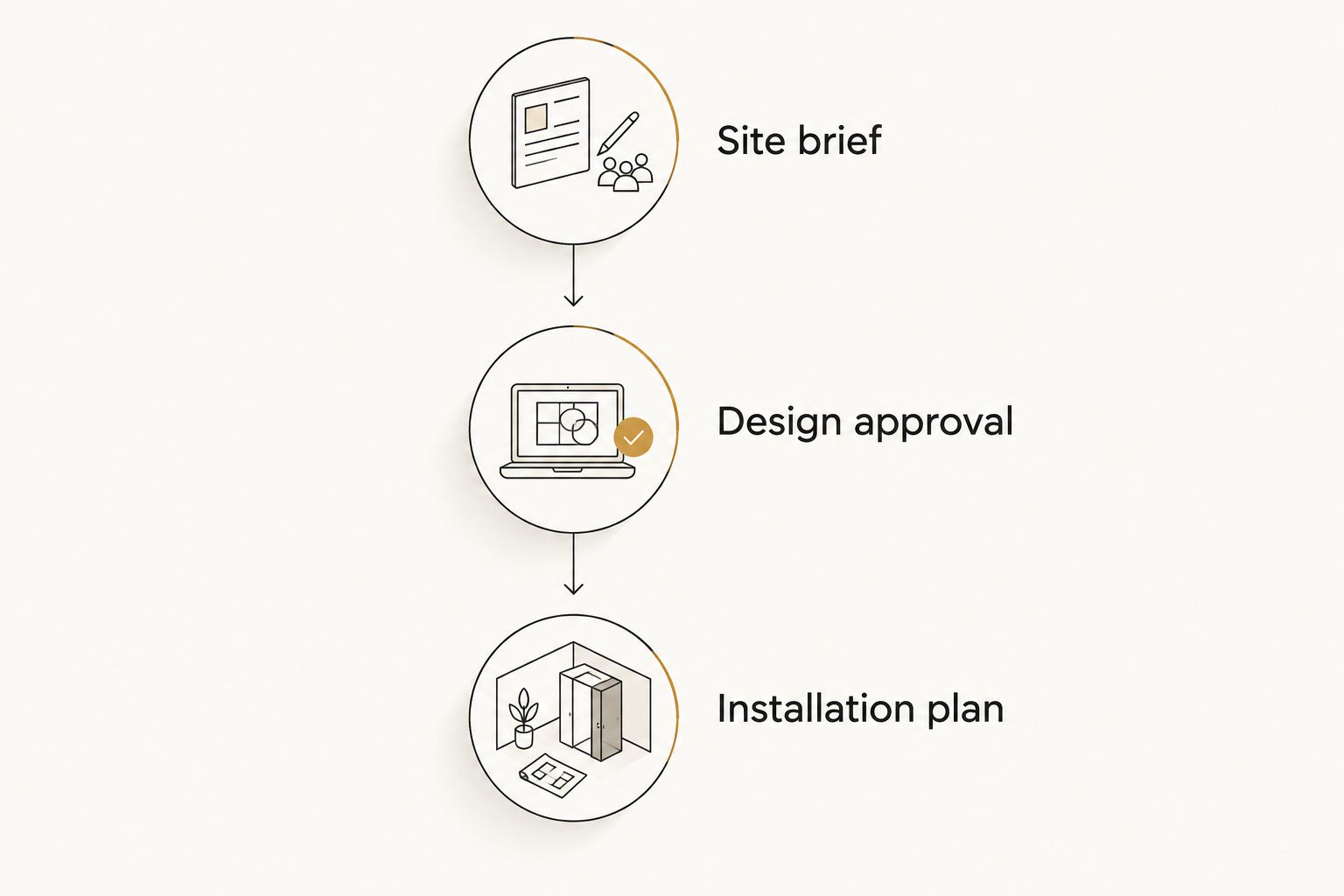
Approve the design and resolve site responsibilities before painting begins.
Keep the wall's current condition visible in the brief. Photograph damage and interruptions, not just the attractive angle. Ask how future cleaning and touch-ups should be handled, and put agreed responsibilities in the project scope.
ARTCVLT Murals gym mural commissions should begin with a wall-specific brief, not a generic inspiration board. Custom artwork needs room to become its own thing.
Give the wall a direction
Bring your location, wall photographs, and project goals to the mural conversation.
Which gym mural idea should you choose?
Choose custom abstract movement if you are undecided and the wall serves a mixed-use training floor. It is the clearest starting point for a composition that does not privilege one activity.
Choose athletic illustration when training identity leads the brief. Choose typography when you have something original to say. Choose a restrained landscape when the room needs less visual competition, and a community narrative when the connection to place is the point.
For an exterior commission, decide whether the building and site can support the artwork before choosing the imagery. Make the wall into a landmark—but solve the wall first.
FAQ
What's the best mural idea for a gym in 2026?
Custom abstract movement is the best default for a mixed-use gym. It suggests motion without centering a single sport, while leaving room to design around equipment and architecture.
Is typography better than an illustrated gym mural?
Typography is better for a concise message; illustration is better for making movement the subject. Choose by the wall's purpose rather than treating either style as universally stronger.
What mural works best in a yoga or Pilates studio?
A restrained landscape is a strong choice when the room needs less visual intensity. Keep the composition simple and review it against instructor placement, mirrors, and sightlines.
What should I send a mural artist before commissioning a gym wall?
Send the location, wall dimensions, clear photographs, project goals, and equipment layout. Include surface concerns, access restrictions, and the person responsible for design approval.
Can a gym mural go on an exterior wall?
An exterior wall is a mural option when its condition, permissions, and installation access support the project. Review exposure and applicable local requirements before committing to the design.
How do I get a quote for a custom gym mural?
Request a project-specific quote using the actual wall and intended scope. Include preparation responsibilities, access needs, design requirements, and operational restrictions so the commission is defined clearly.
Should I choose a mural based on current fitness design trends?
Choose the mural around your gym's identity and the wall's job, not a trend alone. A 2026 reference image is useful direction, but it should not replace an original, site-specific concept.
One last thing
Photograph the wall with the equipment in place before you approve the artwork. Then mark the areas people will never see clearly. Put the strongest part of the composition somewhere else.
A blank wall is not the same as an empty canvas. The room already has a layout. Make the art answer it.