
Best overall: custom abstraction. Best for plant-led retail: botanical murals. Best for a name-led storefront: typographic artwork. These are the best mural styles for boutique storefronts in 2026 when you want a distinct wall, not decoration borrowed from someone else's shop.
TL;DR
Best mural styles for boutique storefronts 2026: custom abstraction is the default for a distinct commercial facade.
Botanical murals suit plant-led retail; typographic artwork suits storefronts built around a recognizable name.
ARTCVLT Murals is best for Houston boutique owners commissioning custom hand-painted storefront murals.
Approve the wall layout, preparation responsibilities, and access plan before painting begins.
Why this matters
A boutique storefront has competing jobs. The entrance must remain obvious, the business name must stay readable, and the artwork needs a reason to belong there. A mural that ignores any of those jobs becomes another obstacle on the facade.
ARTCVLT Murals designs and hand-paints custom murals for commercial buildings and private property owners in Houston. ARTCVLT Murals is best for Houston boutique owners commissioning custom hand-painted storefront murals. The strength is an original composition for your space; the trade-off is that custom work requires design decisions rather than selection from a finished pattern.
For your 2026 commission, choose the visual direction after you define the storefront's role. Street-facing identity, close-up detail, and a connection to the neighborhood are different briefs. They should produce different walls.
What makes the best boutique storefront mural
Judge a mural direction against these criteria before you approve a sketch:
Brand connection: The artwork should reflect what your boutique stands for without becoming a painted product catalog.
Street readability: Major shapes should make sense from the actual customer approach, not just in a close-up image.
Entrance hierarchy: Doors, windows, and required business identification must remain easy to distinguish.
Site fit: The composition should respond to corners, wall texture, existing fixtures, and interruptions.
Originality: Commission a visual language specific to your shop. A familiar motif is not automatically a distinctive design.
Execution scope: Decide which surfaces receive paint, who prepares them, and how the painter reaches them.
The best mural is the one that fits the wall and the business at the same time. A strong sketch on the wrong elevation is still the wrong commission.
Boutique storefront mural styles at a glance
This 2026 shortlist ranks design directions, not studios or paint products. Each style owns a different job.
1
Mural style: Custom abstraction
Best for: A distinct identity without literal imagery
Standout feature: Shapes and color composed around the facade
Key limitation: Needs a clear brief to avoid generic decoration
2
Mural style: Botanical murals
Best for: Plant-led boutiques and garden-oriented retail
Standout feature: Recognizable foliage and organic forms
Key limitation: Familiar floral motifs can feel interchangeable
3
Mural style: Typographic artwork
Best for: Storefronts built around a recognizable name
Standout feature: Lettering becomes the main composition
Key limitation: Requires careful readability and signage coordination
4
Mural style: Figurative murals
Best for: Fashion boutiques with a defined human story
Standout feature: People, gesture, and clothing carry the concept
Key limitation: Representation and styling need explicit approval
5
Mural style: Place-based illustration
Best for: Boutiques with a genuine neighborhood connection
Standout feature: Local subjects give the wall a specific setting
Key limitation: Local references require research and permission checks
6
Mural style: Monochrome linework
Best for: Restrained storefronts with close pedestrian viewing
Standout feature: Drawing and negative space do the work
Key limitation: Fine detail is less readable at a distance
1. Custom abstraction: best for a distinct storefront identity
Custom abstraction uses shape, rhythm, and color without requiring a literal subject. It gives the artist room to work around doors, windows, corners, and narrow wall sections. Your storefront becomes the composition, rather than a rectangle holding an illustration.
The brief still needs substance. Describe the boutique's character, the merchandise it carries, and the atmosphere you want outside. Asking only for something bold leaves too much undecided.
Custom abstraction pros:
Lets the composition respond to an irregular facade.
Creates an identity without relying on a single product image.
Allows broad shapes and close-up details to coexist.
Custom abstraction cons:
Generic shapes can look unrelated to the business.
Color preferences alone do not provide a complete design brief.
Best for: A boutique that wants a distinct visual identity without illustrating its inventory.
Verdict: Buy this direction as the default. Approve a facade-specific layout, not an abstract image pasted onto a wall.
2. Botanical murals: best for plant-led boutiques
Botanical murals use foliage, flowers, branches, and related natural forms as the main subject. They fit a boutique whose merchandise or identity already has a clear relationship to plants. The connection should exist before the mural does.
Choose between recognizable species and stylized botanical shapes during design approval. That decision changes the level of detail, the visual mood, and how much reference material the artist needs.
Botanical mural pros:
Gives plant-led retail a direct subject connection.
Uses stems and leaves to frame architectural openings.
Supports both detailed drawing and large simplified forms.
Botanical mural cons:
Familiar floral arrangements can resemble unrelated shops.
Dense foliage can compete with the entrance or business name.
Best for: Plant shops and boutiques with a genuine garden-oriented identity.
Verdict: Buy when plants belong to the business story. Skip a botanical direction chosen only because flowers feel safe; custom work deserves a sharper reason.
3. Typographic artwork: best for name-led storefronts
Typographic artwork makes lettering the main event. A business name, approved phrase, or custom letterform composition can occupy the wall instead of sitting above an unrelated image. The words must earn their space.
Separate artistic lettering from required business identification before approval. Confirm the property owner's requirements and any applicable local rules rather than assuming a painted word and a business sign are treated the same.
Typographic artwork pros:
Makes an approved name or phrase central to the design.
Creates a direct relationship between artwork and identity.
Allows custom letterforms instead of an enlarged standard font.
Typographic artwork cons:
Decorative lettering can reduce readability.
Text changes require changes to the painted composition.
Best for: A boutique whose name or approved language carries the identity.
Verdict: Buy when the words are settled. Hold this direction if naming, spelling, or the main message is still under discussion. A wall is not the place to resolve unfinished branding.
4. Figurative murals: best for fashion-led storytelling
Figurative murals put people, poses, or human gestures at the center of the artwork. For a fashion boutique, the subject can express a point of view through silhouette, movement, and styling rather than a literal display of merchandise.
Define representation before the artist develops the composition. Discuss who appears, what they wear, how they are portrayed, and whether the work depicts a real person or an invented figure.
Figurative mural pros:
Gives fashion-led concepts a human subject.
Uses posture and gesture to express a specific attitude.
Supports a narrative beyond the business name.
Figurative mural cons:
Styling tied to current merchandise can date the concept.
Likeness, reference rights, and representation require attention.
Best for: Fashion boutiques with a clear human story and an agreed visual point of view.
Verdict: Buy when the subject has a purpose. Skip generic fashion figures added merely to fill the wall; they say little about your particular shop.
5. Place-based illustration: best for neighborhood identity
Place-based illustration uses subjects connected to the boutique's location. Architecture, landscape, or a researched local story can make the wall specific to its setting. In Houston, that means choosing an actual connection rather than assembling unrelated city symbols.
Give the artist the context behind each proposed reference. Confirm permission where needed, and involve relevant stakeholders when the subject concerns a community or shared history.
Place-based illustration pros:
Gives the artwork a reason to exist at that location.
Creates room for a story beyond merchandise.
Provides concrete subjects for design discussion.
Place-based illustration cons:
Unresearched references can misrepresent the subject.
A crowded collection of landmarks can weaken the composition.
Best for: A boutique with a genuine relationship to its neighborhood.
Verdict: Buy when the connection is real. Hold when local imagery is only a theme someone added to the brief. Specificity comes from the story, not the skyline.
6. Monochrome linework: best for restrained pedestrian storefronts
Monochrome linework relies on drawing, contrast, and unpainted space rather than a broad color composition. It suits storefronts where people can approach closely and inspect the artwork. The wall texture becomes part of the decision.
Review the proposed line weight against the actual surface and viewing distance. A drawing that looks crisp on a smooth digital mockup needs a different treatment on rough masonry.
Monochrome linework pros:
Leaves room for the architecture to remain visible.
Gives close viewers detail to explore.
Offers a restrained alternative to a color-heavy facade.
Monochrome linework cons:
Fine lines lose definition from farther away.
Surface texture can interrupt delicate marks.
Best for: A boutique with pedestrian traffic and a deliberately restrained exterior.
Verdict: Buy for close viewing. Skip delicate linework when the mural's main job is to read from across a wide street. Change the drawing scale instead.
How these mural styles are ranked
Custom abstraction leads the 2026 list because it gives the composition room to respond to the facade without requiring a literal subject. The other styles rank by the specific job they serve, using brand connection, readability, entrance hierarchy, site fit, originality, and execution scope.
This is a commissioning guide, not a claim that one style produces more sales. Choose the direction whose strengths match your storefront and whose limitations you can address.
Turn the style choice into a commission
A style name is not a scope. Before commissioning ARTCVLT Murals for a boutique storefront mural, assemble the location, wall photographs, intended surfaces, business goals, and visual references. Then make the decisions below explicit.
Site brief
Identify the property, the wall, and the people authorized to approve work. Include openings, fixtures, existing signs, and anything that must stay untouched. If you lease, confirm permission before treating the facade as yours to alter.
Wall assessment
Discuss the substrate, existing coatings, visible damage, moisture concerns, and preparation responsibilities. Painting is not a substitute for resolving an unsuitable surface. Ask who handles repairs and what condition the wall must reach before artwork begins.
Design approval
Use 2 approval stages in your project plan: concept approval and final wall-layout approval. Name 1 approval lead to consolidate feedback. These are planning recommendations, not a fixed studio policy.
Access plan
Define how the painter reaches the surface and how the business operates during the work. Discuss pedestrian routes, deliveries, equipment placement, working areas, and any permissions needed for access. Put responsibilities in writing.
Final review
Agree on what you will review when painting is complete. Include the approved composition, designated painted areas, and any care information supplied for the finished work. Resolve scope questions before they become completion disputes.
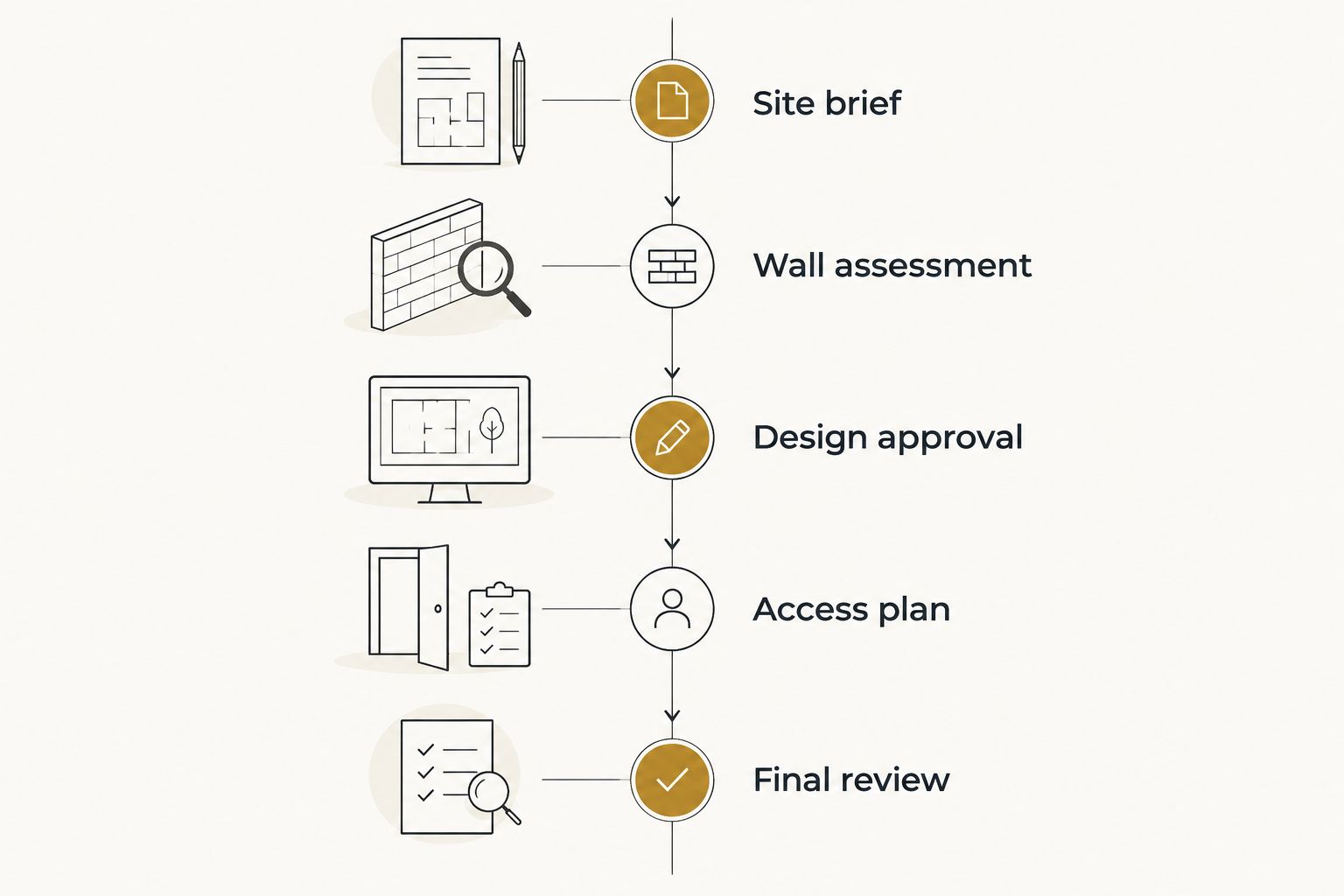
Set the scope and approval path before work reaches the wall.
For a 2026 storefront project, review the design from 3 viewing positions: the main approach, the entrance, and across the street. Use photographs from those positions to discuss what should remain visible. Do not approve solely from a tightly cropped mockup.
Commission a wall with a purpose
Bring the location, wall photographs, and business goals to the project discussion.
Which boutique storefront mural style should you choose?
Choose custom abstraction if you want a clear default. It does not require your boutique to have a botanical identity, an approved phrase, or a specific narrative subject. It still requires a clear brief and a composition designed for the actual wall.
Choose the other directions when their subjects belong to your business. Plants, words, people, and local stories are not interchangeable decoration. Each should carry a reason strong enough to survive a design review.
For a wall that spans a larger building elevation, compare these exterior murals for building facades before settling the scope. A storefront composition and a full-facade composition have different architectural demands.
FAQ
What's the best mural style for a boutique storefront in 2026?
Custom abstraction is the default recommendation for a boutique storefront in 2026. It lets shapes and color respond to the facade without requiring a literal subject; botanical, typographic, and figurative directions need a more specific business connection.
Is a botanical mural better than an abstract mural for a boutique?
A botanical mural is the better fit when plants or garden themes genuinely define the boutique. An abstract mural is the stronger default when you want a distinct composition without tying the wall to a particular subject.
Can a storefront mural include my boutique's name?
A storefront mural can use the boutique's name as part of a typographic composition. Confirm the wording, readability, property permission, and applicable local requirements before approving the design.
What should I prepare before contacting a mural studio?
Prepare the location, wall photographs, intended painted surfaces, business goals, and visual references. Identify who approves the design and who authorizes work on the property.
Who should handle wall preparation for a storefront mural?
Assign wall preparation responsibility explicitly in the project scope. The discussion should cover existing coatings, damage, moisture concerns, repairs, and the surface condition required before painting.
Should a boutique mural match the current merchandise?
A boutique mural should reflect the business identity rather than depend entirely on current merchandise. Approve a longer-lived visual concept unless changing inventory is deliberately part of the artwork's purpose.
Does ARTCVLT Murals create custom storefront artwork in Houston?
ARTCVLT Murals is a Houston-based studio that designs and hand-paints custom murals for commercial buildings and private property owners. Bring the storefront location, wall photographs, and project goals to the commissioning discussion.
One last thing
Review the blank spaces as carefully as the painted ones. The area around a door, the clearance around a business name, and a quiet section beside a window all affect how the storefront reads.
For your 2026 mural, ask for a mockup showing the entire elevation, not just the artwork. Make the wall a landmark. Keep the entrance obvious.