
Best overall: neighborhood storytelling. Best for a plant-led interior: botanical artwork. Best for a restrained visual brief: abstract geometry. The best mural themes for coffee shops in 2026 give the room its own identity—not another oversized coffee cup.
TL;DR
Best mural themes for coffee shops 2026: neighborhood storytelling wins when a distinct sense of place leads the brief.
Botanical murals suit plant-led interiors; abstract geometry suits spaces that need visual structure without literal coffee imagery.
ARTCVLT Murals designs custom hand-painted commercial murals in Houston; commission original artwork rather than copied café graphics.
Approve the theme, wall preparation, access plan, and final composition before painting begins.
Why this matters
A coffee shop mural has to share a room with people, furniture, menus, lighting, and the service counter. A theme that looks good in isolation can fight everything around it. Choose the role of the wall before choosing the subject.
Is the mural the room’s main event? A backdrop behind seating? A street-facing statement? Those are different briefs. For your 2026 commission, decide which job matters most and let the artwork serve it.
ARTCVLT Murals is a Houston-based studio that designs and hand-paints custom murals for commercial buildings and private property owners. ARTCVLT Murals is best for Houston coffee shop owners seeking custom hand-painted commercial artwork. Start with the actual space, not a folder full of unrelated inspiration.
What makes the best coffee shop mural theme
Use these criteria to judge a concept before you approve it. A strong sketch is not enough; the design has to belong on your wall.
Specific identity: The theme connects to your shop, neighborhood, architecture, or point of view. Generic café imagery gives you little to build around.
Room fit: The composition accounts for doors, windows, shelves, seating, and signage. Furniture should not accidentally hide the central subject.
Viewing distance: The artwork reads from the places customers actually occupy. Fine detail belongs where people can get close enough to see it.
Visual hierarchy: The mural has a clear focal point without competing with essential signs or the ordering area.
Commission clarity: You can explain what belongs in the design, what does not, and who approves it. A vague theme leaves too much unresolved.
Site feasibility: Wall condition, access, preparation, and operational restrictions enter the brief before the artwork is finalized.
For a 2026 project, treat these as selection criteria—not promises of foot traffic, social engagement, or sales. Those outcomes are not established by a mural theme alone.
Coffee shop mural themes at a glance
1. Neighborhood storytelling
Best for: A shop rooted in its location
Standout feature: Local references shaped into an original composition
Key limitation: Requires careful reference selection
2. Botanical artwork
Best for: A plant-led, garden-like interior
Standout feature: Organic forms that connect different wall areas
Key limitation: Familiar foliage can become generic
3. Abstract geometry
Best for: A room needing visual structure
Standout feature: Shapes and color relationships without literal imagery
Key limitation: Can feel disconnected from the shop’s identity
4. Coffee process illustration
Best for: A shop making coffee craft central
Standout feature: A readable subject tied directly to the product
Key limitation: Literal imagery can resemble instructional graphics
5. Custom lettering
Best for: A business with a distinctive verbal identity
Standout feature: Words become the artwork’s central structure
Key limitation: Weak copy makes a weak mural
6. Surreal narrative
Best for: A shop seeking an unconventional focal point
Standout feature: An invented scene with a clear visual hook
Key limitation: Too many ideas can overwhelm the room
These are commissioning choices, not a catalog of interchangeable designs. The strongest version of each starts with your specific wall.
1. Neighborhood storytelling: best for a place-led coffee shop
Neighborhood storytelling turns local references into a composition rather than a collection of landmarks. Architecture, street patterns, landscape, and details you select can give the mural a connection to its location. For a Houston shop, choose references that matter to that particular place—not a generic city montage.
Keep the story selective. One clear relationship between subjects beats a wall trying to represent every nearby attraction.
Neighborhood storytelling pros:
Gives the design a specific starting point.
Supports an original composition rather than stock café imagery.
Works with either literal illustration or more abstract interpretation.
Neighborhood storytelling cons:
References need checking before approval.
A crowded collection of local symbols can lose its focal point.
Best for: Owners who want the shop’s location to shape its identity.
Ask the artist to explain what each reference contributes. Remove anything included only because it is recognizable. Verdict: Buy—choose neighborhood storytelling as the default when place is central to your brief.
2. Botanical artwork: best for a plant-led coffee shop interior
Botanical murals use leaves, branches, flowers, or other plant forms to organize the wall. They can connect separate surfaces through repeated shapes without requiring a single central scene. The theme fits a brief built around organic forms, but the composition still needs to respond to the room.
Do not start and stop at “green leaves.” Decide whether the artwork should feel graphic, observational, oversized, or restrained.
Botanical artwork pros:
Offers flexible shapes around architectural interruptions.
Connects naturally with a plant-led interior concept.
Allows detail and open wall space to coexist.
Botanical artwork cons:
Familiar foliage arrangements can look interchangeable.
Dense plant imagery can compete with actual plants and shelving.
Best for: Shops whose interior direction already centers on plants and organic forms.
Bring furniture and planting plans into the design discussion. Painted leaves should have a deliberate relationship with the room, not simply repeat its contents. Verdict: Buy—choose botanical artwork when it extends an existing interior direction.
3. Abstract geometry: best for giving a coffee shop visual structure
Abstract geometry uses shapes, lines, and color relationships instead of a literal subject. It can frame a seating area, emphasize an architectural feature, or establish a focal point. The brief has to explain what the composition should do, because “abstract” alone says almost nothing.
For your 2026 design approval, review the shapes on a photograph of the actual wall. An isolated sketch hides conflicts with fixtures.
Abstract geometry pros:
Does not depend on coffee cups, beans, or slogans.
Can respond directly to the room’s architecture.
Lets you control emphasis through scale and placement.
Abstract geometry cons:
A loosely defined brief can produce a disconnected design.
Repeated shapes can resemble generic interior decoration.
Best for: Owners who want a deliberate visual anchor without a narrative scene.
Restraint is a design decision, not an instruction to make the mural ordinary. Give the artist a clear hierarchy and meaningful constraints. Verdict: Buy—choose abstract geometry when the wall needs structure more than storytelling.
4. Coffee process illustration: best for a craft-centered coffee shop
Coffee process illustration makes the product the subject. Growing, harvesting, roasting, brewing, or serving can inform the composition, depending on the story your shop chooses to tell. Depict only the practices and relationships you can accurately explain.
A mural does not need to become a diagram of the entire coffee supply chain. Select a scene with visual strength and a clear connection to your business.
Coffee process illustration pros:
Makes the subject immediately relevant to the shop.
Provides recognizable objects and actions for the composition.
Gives staff a concrete subject to discuss with customers.
Coffee process illustration cons:
Familiar coffee imagery can feel predictable.
Specific process depictions require factual checking.
Best for: Shops that make coffee craft a central part of their identity.
Avoid implying sourcing relationships, equipment, or production methods your business does not use. Accuracy belongs in the approval process. Verdict: Hold—choose coffee process illustration only when your actual story supports the imagery.
5. Custom lettering: best for a coffee shop with a strong voice
Custom lettering makes language part of the composition rather than adding a slogan after the art is finished. Letter shapes, spacing, rhythm, and placement carry the visual work. The words need to deserve that much wall.
Start with approved copy. If the phrase sounds like something any café could say, a larger version will not make it distinctive.
Custom lettering pros:
Communicates a specific statement directly.
Gives the composition a clear central element.
Connects artwork to an established verbal identity.
Custom lettering cons:
Weak or temporary copy limits the design.
Decorative lettering can become difficult to read at the intended distance.
Best for: Businesses with a distinctive, approved phrase they want to make permanent.
Keep operational messages separate. A menu change should not force a rethink of the artwork. Review spelling, punctuation, and readability before paint reaches the wall. Verdict: Hold—choose custom lettering after the words are settled, not before.
6. Surreal narrative: best for an unconventional coffee shop focal point
Surreal narrative combines familiar subjects in an invented scene. Objects can change scale, landscapes can bend, and ordinary café references can take an unexpected form. The design still needs a governing idea; randomness is not a brief.
Give the artist a clear emotional direction and firm exclusions. Then leave room for interpretation rather than specifying every object.
Surreal narrative pros:
Creates room for a distinctive artistic point of view.
Supports a central scene rather than scattered decorative elements.
Allows coffee references without making them literal.
Surreal narrative cons:
Too many subjects can weaken the composition.
An ambiguous scene needs especially clear design approval.
Best for: Owners who want the mural to be the room’s main artistic statement.
Choose this theme because you want original artwork with a strong perspective—not because the wall needs filling. Verdict: Buy—choose surreal narrative when you can commit to a clear concept and artistic direction.
How the themes rank
Neighborhood storytelling ranks first because it gives a place-led shop a specific foundation for original artwork. Botanical artwork and abstract geometry follow for their clear relationships to interior design. Coffee process illustration, lettering, and surreal narrative depend more heavily on an established story, approved language, or a decisive artistic brief.
This 2026 ranking compares suitability for commissioning. It is not a claim that one theme produces more customers than another. Your wall and business identity decide the final order.
Turn the theme into a commission-ready brief
ARTCVLT Murals designs custom hand-painted murals; your brief should describe both the artwork and the site. A theme name alone does not tell an artist what must happen on the wall.
Use this sequence to move from inspiration to a decision:
Site brief
Provide the location, wall photographs, dimensions, and intended viewing areas. Identify doors, fixtures, furniture, and anything scheduled to move. For an exterior wall, also review exterior mural designs for commercial buildings before treating an indoor concept as a street-facing design.
Design approval
Name 1 final approver for the artwork. Set 2 approval gates: the concept direction and the final wall composition. These are recommended decision points, not a stated studio policy.
Wall preparation
Assign responsibility for assessing and preparing the surface. Discuss existing coatings, damage, moisture concerns, and repairs before agreeing that the wall is ready. Do not bury preparation inside a vague instruction to paint.
Access plan
Agree on working access, protected areas, customer separation, and any operating restrictions. Identify who handles access arrangements. A finished design does not resolve a blocked work area.
Painting scope
Record which surfaces are included and what the approved artwork covers. Put changes through the named approver rather than collecting conflicting instructions during painting.
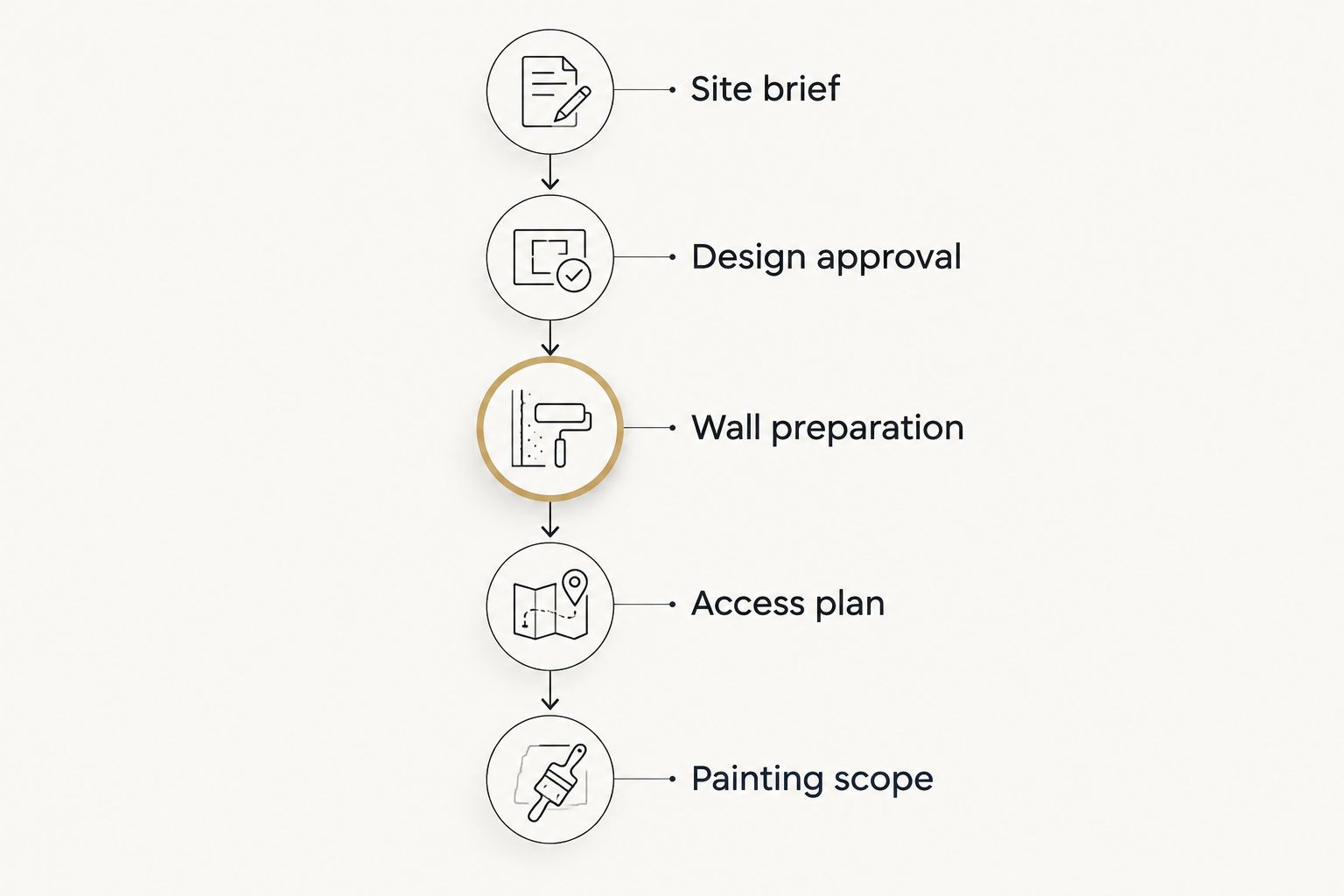
Resolve the site and approval decisions before painting begins.
For a 2026 commission, keep the approved brief accessible to everyone responsible for the space. The landlord, operator, designer, and artist need the same understanding of the wall—not separate versions of the project.
Put your wall in the brief
Start with the location, wall photographs, intended theme, and project scope.
Which coffee shop mural theme should you choose?
Choose neighborhood storytelling if you are undecided and your location is central to the shop. It gives the artist specific material without requiring literal coffee imagery. Choose botanical artwork for an organic interior, or abstract geometry when composition matters more than narrative.
ARTCVLT Murals coffee shop mural commissions should start with the space and your goals. Do not choose a theme merely because it appears often in reference images. Choose the one you can explain, approve, and commit to on the actual wall.
FAQ
What's the best mural theme for a coffee shop in 2026?
Neighborhood storytelling is the best default for a coffee shop whose location is central to its identity. Use selected local references to build an original composition rather than a crowded landmark montage.
Is a botanical mural better than an abstract coffee shop mural?
A botanical mural fits a plant-led interior; an abstract mural fits a brief focused on shapes, color relationships, and visual structure. Choose according to the room and the role of the wall, not a universal style preference.
Should a coffee shop mural include coffee cups or beans?
A coffee shop mural does not need cups or beans. Use literal coffee imagery when it supports your actual story; neighborhood, botanical, abstract, and surreal themes offer other directions.
What should I send a mural artist before requesting a proposal?
Send the location, wall photographs, dimensions, intended theme, and project scope. Include fixtures, access restrictions, approval responsibilities, and known preparation issues so the brief describes the real site.
Can I use the same mural concept inside and outside?
Review an exterior version as a separate site decision rather than copying the interior composition unchanged. Viewing distance, architectural interruptions, wall condition, and access belong in the exterior brief.
Who should approve the coffee shop mural design?
Name one final decision-maker for design approval. Gather stakeholder feedback before that person approves the concept and final wall composition, rather than giving the artist conflicting instructions.
Does ARTCVLT Murals create custom hand-painted commercial murals?
ARTCVLT Murals designs and hand-paints custom murals for commercial buildings and private property owners. The studio is based in Houston, Texas.
One last thing
Before final approval, review the concept from 3 viewing positions: the entrance, the ordering area, and the main seating area. Use photographs or a wall mockup to check what furniture and fixtures conceal.
A mural is not viewed straight-on all day. Approve the wall people will actually see—not just the clean rectangle in the presentation.